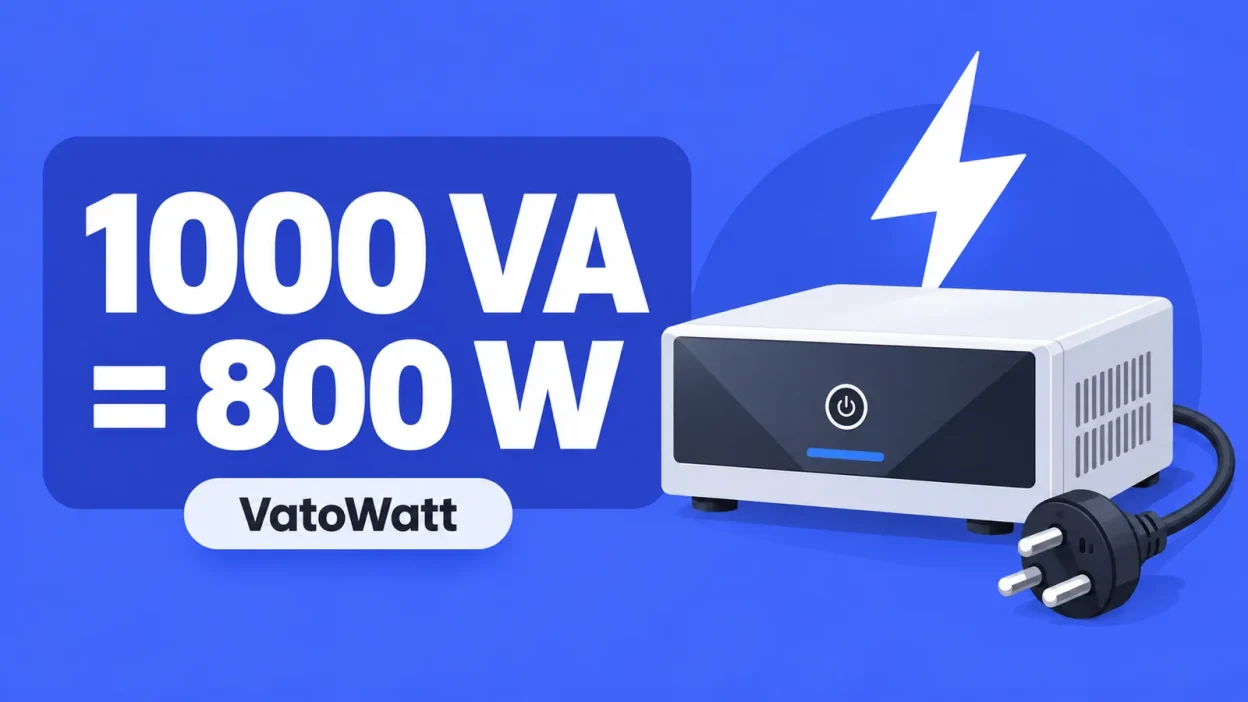
1000 VA to watts equals 800 W at a power factor (PF) of 0.8, the common planning value used by this calculator. The exact watt capacity depends on the power factor and the inverter or UPS nameplate, so the 800 W figure is a useful starting point—not a promise that every 1000 VA unit can supply 800 W.
1000 VA = 800 W: the quick answer
Use this calculation:
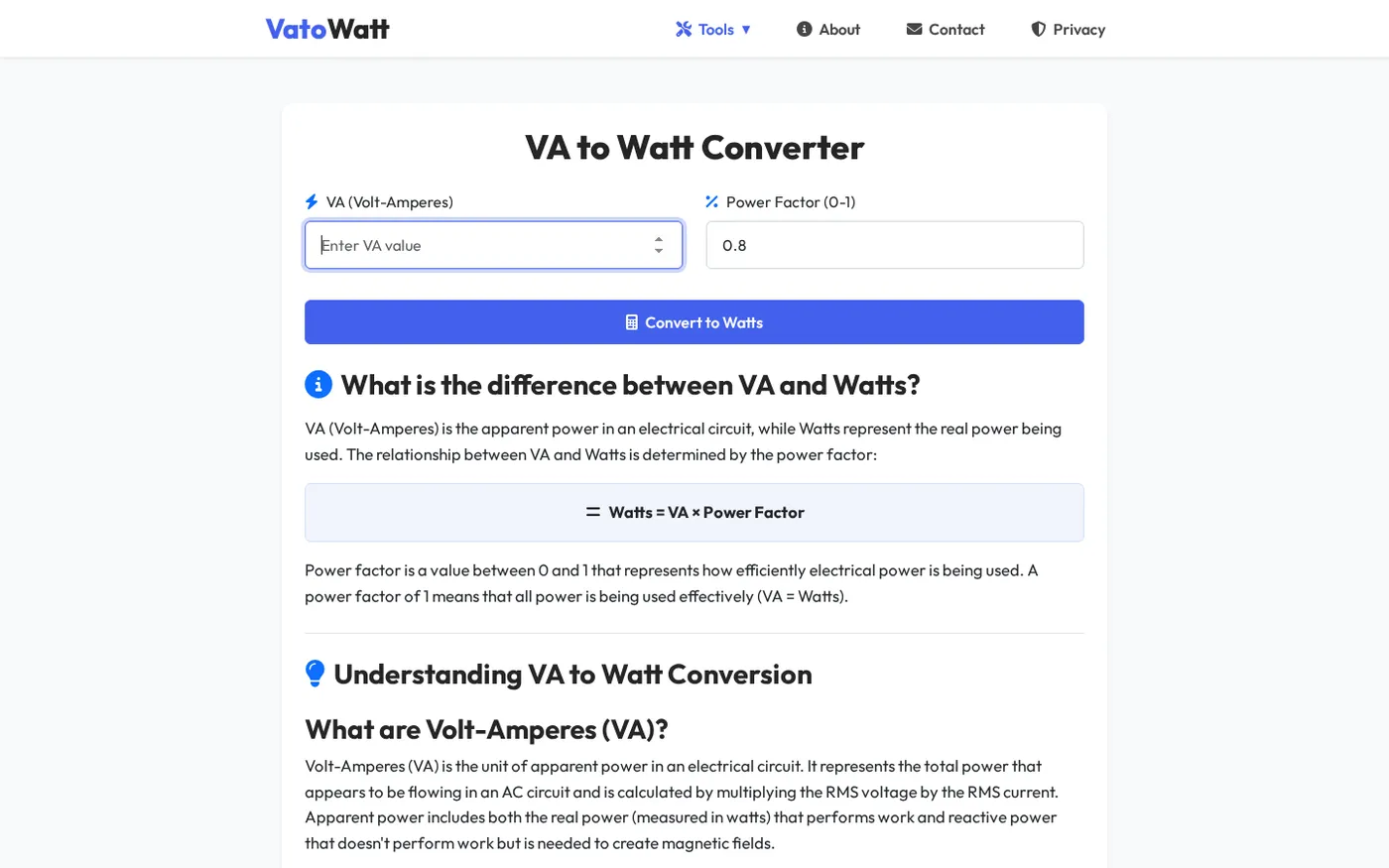
Watts = VA × power factor
      = 1,000 × 0.8
      = 800 W
So, a 1000 VA inverter rated at PF 0.8 has an estimated active-power capacity of 800 W. If its specification label gives a different watt limit, use that stated limit. VA describes apparent power, while watts describe real power delivered to appliances.
Re-run the calculation with your own PF in the VA to Watt Converter, which starts at 0.8.
The formula: watts = VA × power factor
VA means volt-amperes, or apparent power. It represents total demand made up of real and reactive power. Watts measure real or active power—the part that produces light, heat, movement or useful electronic work. The US Energy Information Administration glossary defines both terms.
Power factor is the ratio between real power and apparent power. A PF of 1.0 means the watts and VA are numerically equal. At PF 0.8, only 80% of the VA figure appears as real watts:
PF = watts ÷ VA
watts = VA × PF
Two 1000 VA UPS units can therefore show different watt limits. Legrand’s UPS technical guide also notes that both the rated PF and the load’s actual PF matter.
1000 VA in watts at different power factors
The table below keeps the VA rating fixed at 1,000 and changes only the PF. It is a conversion table, not a claim about the PF of every appliance.
| Power factor | Calculation | 1000 VA in watts |
|---|---|---|
| 0.6 | 1,000 × 0.6 | 600 W |
| 0.7 | 1,000 × 0.7 | 700 W |
| 0.8 | 1,000 × 0.8 | 800 W |
| 0.9 | 1,000 × 0.9 | 900 W |
| 1.0 | 1,000 × 1.0 | 1,000 W |
If the inverter label lists both values, such as 1000 VA and 800 W, its implied PF is:
800 W ÷ 1,000 VA = 0.8If the label lists 1000 VA and 600 W, plan around 600 W. Do not replace the manufacturer’s watt limit with a generic 0.8 assumption.
What can a 1000 VA inverter run?
Here is an illustrative small-home load using assumed running watts. Appliance wattage varies, so read your own labels before sizing an inverter.
| Appliance | Assumed watts | Quantity | Total watts |
|---|---|---|---|
| Ceiling fan | 70 W | 3 | 210 W |
| LED bulb | 9 W | 4 | 36 W |
| TV | 100 W | 1 | 100 W |
| Wi-Fi router | 12 W | 1 | 12 W |
| Refrigerator while running | 150 W | 1 | 150 W |
| Total | 508 W |
The example totals 508 W, below the 800 W planning figure. With a simple PF 0.8 estimate, its apparent demand would be:
508 W ÷ 0.8 = 635 VAThat is below 1,000 VA as well. A refrigerator compressor and other motor loads can demand more when starting, so check the inverter’s surge capability and the actual appliance specifications.
For an appliance-by-appliance check, use the Inverter Load Calculator and enter each appliance’s watts and quantity.
Should you use the full 800 W?
Treat 800 W as the calculated active-power ceiling for the 0.8 example, not as a target load. The practical limit is the lowest applicable limit among the inverter’s watt rating, VA rating, surge capability and connected appliances.
Before you connect a load, check these points:
- Add the running watts from the appliance labels.
- Compare that total with the inverter’s stated maximum watts.
- Convert watts to VA when you need to check the apparent-power limit:
VA = watts ÷ PF. - Account for starting demand from compressors, pumps or other motor loads.
- Keep ordinary operating headroom instead of designing around an exact maximum.
For example, a 700 W total is below 800 W but too high for a unit whose own label says 600 W.
If you know the watt load, use the Watt to VA Converter to find the required VA rating.
How long will a 1000 VA inverter last on one battery?
VA-to-watt conversion tells you whether the inverter can support a load. It does not tell you how long the battery will run it. Runtime depends mainly on battery capacity, battery voltage, load watts and usable efficiency.
For a quick estimate, use:
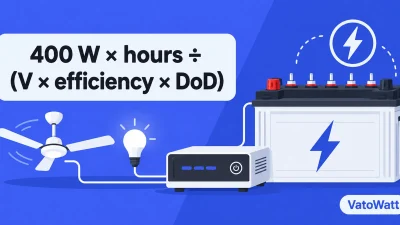
Runtime in hours ≈ battery Ah × battery V × usable efficiency ÷ load WUsing a 150 Ah, 12 V battery and a usable-efficiency assumption of 0.8:
Usable energy = 150 Ah × 12 V × 0.8
              = 1,440 Wh
The estimated runtime at different loads is:
| Load | Calculation | Estimated runtime |
|---|---|---|
| 300 W | 1,440 Wh ÷ 300 W | 4.8 hours |
| 508 W | 1,440 Wh ÷ 508 W | 2.83 hours |
| 800 W | 1,440 Wh ÷ 800 W | 1.8 hours |
These are worked estimates, not guaranteed backup times. Battery age, temperature, discharge rate, inverter losses and the battery’s usable discharge limit can change the result. Enter your own Ah, voltage and load in the Battery Backup Calculator for a re-usable estimate.
Common mistakes with 1000 VA UPS ratings
- Assuming VA always equals watts: that is true only at PF 1.0; at PF 0.8, 1000 VA is 800 W.
- Ignoring the nameplate watt limit: a manufacturer’s 600 W limit remains 600 W even when VA is 1000.
- Sizing only for running watts: a fridge or pump may need extra starting capacity.
- Confusing power with energy: watts describe the load; watt-hours describe energy over time.
FAQ
Is 1000 VA equal to 1000 watts?
Not always. It equals 1000 W only at a power factor of 1.0; at PF 0.8, it equals 800 W. Always check the inverter’s stated watt capacity and PF.
How many watts can a 1000 VA UPS handle?
At PF 0.8, the conversion gives 800 W. The UPS may have a different manufacturer-rated watt limit, so use the lower stated limit when it differs.
Can a 1000 VA inverter run a refrigerator?
It may run a refrigerator if the running watts, apparent demand and starting demand fit the inverter’s specifications. Check the refrigerator label and the inverter’s surge rating before relying on it during a power cut.
What battery is needed for a 1000 VA inverter?
The VA number alone cannot determine battery size. You need the load in watts and the desired backup time, then use the battery voltage, Ah capacity and usable efficiency in the calculation.