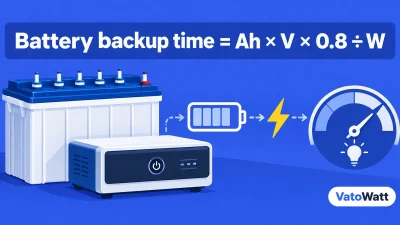
How much Ah battery required for home depends on the watts you want to run, the backup hours you need, the battery-bank voltage and the usable battery capacity. For a practical Indian home estimate, calculate the load first, then use the inverter-load formula with 85% inverter efficiency and 50% depth of discharge (DoD).
What you need before calculating
Keep these four inputs ready:
- The appliances you want to run during a power cut, with their wattage and quantity.
- The number of backup hours you want, such as 4, 6 or 8 hours.
- The battery-bank voltage supported by your inverter: usually 12 V or 24 V for a small home system, with 48 V used in larger systems.
- The inverter efficiency and the usable DoD specified for your system. If you do not have those figures, start with VatoWatt’s 85% efficiency and 50% DoD defaults.
Do not choose Ah from the size of your home alone. A 2BHK with two fans and a few lights needs a different battery from a 2BHK that also runs a fridge, desktop computer or cooler.
Step 1: List the load you want to back up
Why this matters: battery capacity is based on the watts running during the outage, not on the inverter’s VA label or the number of rooms.
- Write down only the appliances you genuinely need during a power cut.
- Read the wattage on each appliance label or in its manual. If a device shows amps, use its rated watts if available rather than guessing.
- Multiply watts by quantity, then add the appliances that may run at the same time.
- Keep motor loads such as a fridge, pump or cooler in the list even when their running wattage looks small. Their starting surge affects inverter sizing.
Here is a simple worked load for illustration. The exact wattage of your appliances may be different.
| Appliance | Quantity | Example watts each | Total |
|---|---|---|---|
| Ceiling fan | 3 | 70 W | 210 W |
| LED bulb | 4 | 9 W | 36 W |
| Wi-Fi router | 1 | 10 W | 10 W |
| Television | 1 | 100 W | 100 W |
| Calculated running load | 356 W |
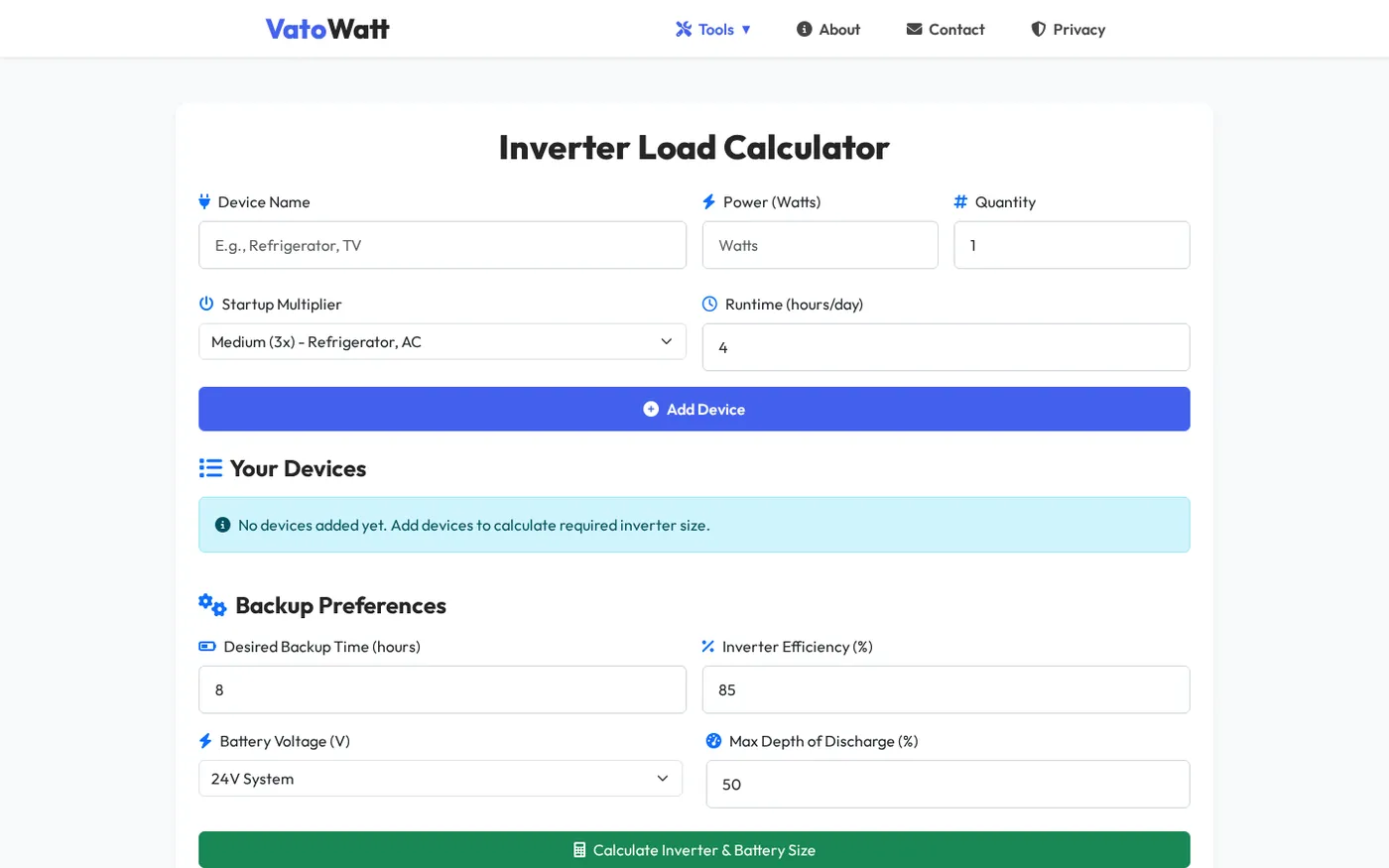
For the worked battery examples below, we will use a rounded planning load of 400 W. If you want to measure daily appliance use separately, use the Power Consumption Calculator, then return here for backup sizing.
Step 2: Choose the backup time and battery voltage
Why this matters: doubling the backup time doubles the required energy, while doubling the battery-bank voltage halves the Ah number for the same energy.
Decide what “backup” means for you. Four hours of fans, lights and Wi-Fi is a different target from eight hours overnight. Write down one target instead of choosing a battery by habit.
Next, check the inverter label or manual for its battery-bank voltage. Use 12 V in the formula for a 12 V inverter and 24 V for a 24 V inverter. Do not treat 12 V and 24 V as interchangeable: a 24 V inverter needs a correctly configured 24 V battery bank.
Step 3: Use the Ah battery capacity formula
Why this matters: the formula converts the energy your AC appliances need into the nominal ampere-hours your battery bank must provide.
Use this estimate:
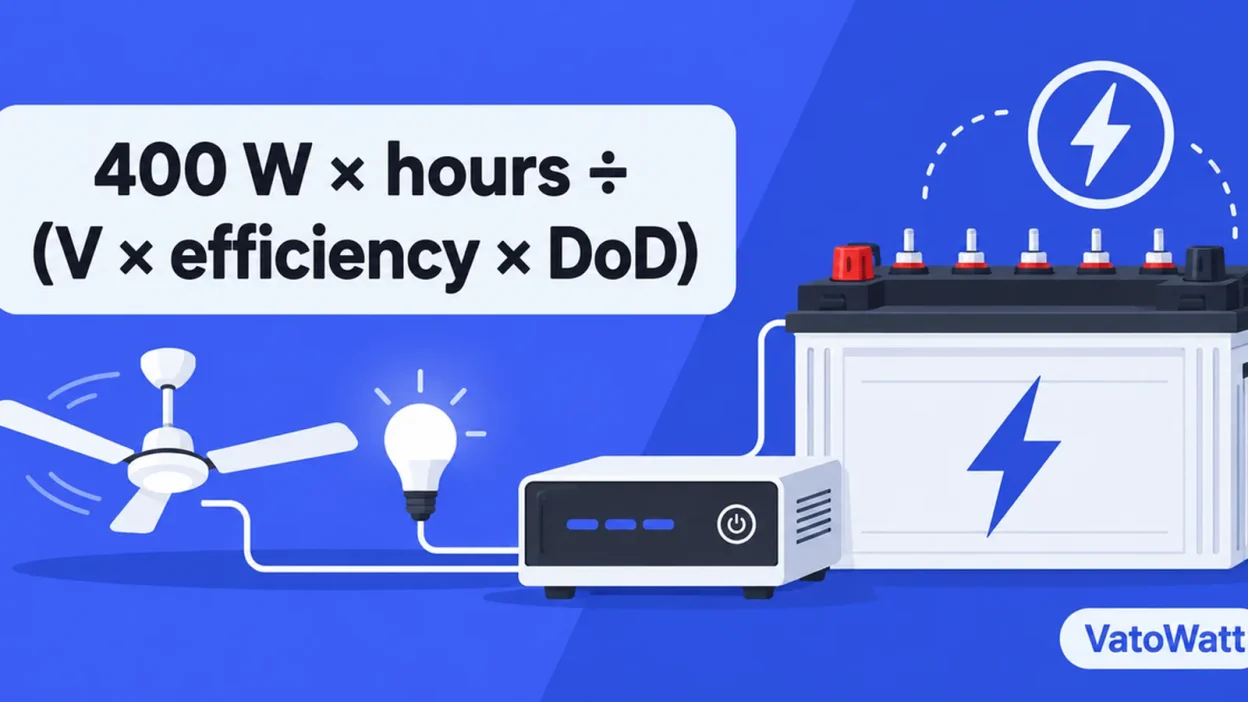
Required battery Ah = Load (W) × Backup time (h)
                     ───────────────────────────────
                     Battery voltage (V) × Efficiency × DoD
With the VatoWatt defaults, the bottom part for a 12 V system is 12 × 0.85 × 0.50 = 5.1.
For a 400 W load and 4 hours of backup on a 12 V bank:
Required Ah = 400 × 4 ÷ (12 × 0.85 × 0.50)
            = 1,600 ÷ 5.1
            = 313.7 Ah
Round up at the end, so the design result is 314 Ah. A single 150 Ah battery is not a four-hour answer for this 400 W example under these assumptions.
The same load and hours on a 24 V bank gives 1,600 ÷ (24 × 0.85 × 0.50) = 156.9 Ah, or 157 Ah. The energy requirement has not disappeared; the higher voltage means fewer ampere-hours in the bank.
| Backup target | Required at 12 V | Required at 24 V | Calculation uses |
|---|---|---|---|
| 4 hours | 314 Ah | 157 Ah | 400 W × 4 h |
| 6 hours | 471 Ah | 235 Ah | 400 W × 6 h |
| 8 hours | 628 Ah | 314 Ah | 400 W × 8 h |
These are calculated requirements, not a recommendation to connect batteries yourself. Enter your own load and target in the Inverter Load Calculator to include appliance quantity, running time and surge factors.
Step 4: Understand efficiency and depth of discharge
Why this matters: a battery does not deliver all of its nominal stored energy to your AC appliances.
The 85% efficiency factor represents energy lost while the inverter converts DC battery power into AC power. If your inverter documentation gives a different efficiency at your expected load, use that figure instead.
The 50% DoD factor means the calculation plans to use half of the battery’s nominal capacity. For example, a 150 Ah, 12 V battery has 1,800 Wh of nominal energy:
150 Ah × 12 V = 1,800 Wh nominal
1,800 Wh × 0.50 × 0.85 = 765 Wh delivered in this estimate
At a 400 W load, that is 765 ÷ 400 = 1.91 hours, before other real-world effects. A simple calculation that divides only by voltage would say 400 × 4 ÷ 12 = 133 Ah for four hours, but it assumes ideal conversion and a fully usable battery. That is why it can leave you with a much smaller battery than the load actually needs.
Victron’s inverter manual also starts with appliance watts multiplied by operating time, includes inverter losses and converts the resulting watt-hours to battery Ah. Read the battery-capacity calculation in the Victron manual when you want to compare the method with your inverter’s documentation.
DoD is a design choice, not a universal constant. Battery University explains that manufacturers use different DoD conventions and that avoiding full discharges reduces battery stress. See its discharge and DoD explanation, then follow the limits for your exact battery model.
Step 5: Compare 100 Ah, 150 Ah, 200 Ah and 220 Ah
Why this matters: common battery labels are easy to compare only when load, voltage and usable DoD stay the same.
The table below assumes one 12 V battery bank, a 400 W load, 85% inverter efficiency and 50% DoD. It shows the estimated runtime, not a guarantee of the exact time in your home.
| Battery bank | Usable energy in this estimate | Estimated runtime at 400 W |
|---|---|---|
| 100 Ah | 510 Wh | 1.28 hours, about 1 h 17 min |
| 150 Ah | 765 Wh | 1.91 hours, about 1 h 55 min |
| 200 Ah | 1,020 Wh | 2.55 hours, about 2 h 33 min |
| 220 Ah | 1,122 Wh | 2.81 hours, about 2 h 48 min |
So, is 150 Ah or 200 Ah better? For the same 400 W load, the 200 Ah bank gives about one-third more calculated runtime than the 150 Ah bank. It still does not reach four hours in this example; that target needs about 314 Ah at 12 V or 157 Ah at 24 V.
The printed Ah rating is normally tied to a specified test condition. Actual runtime changes with discharge rate, battery age, temperature, voltage cutoff and the inverter’s own idle consumption. Use the table for a first estimate, then check the battery datasheet and run the numbers in the calculator.
Step 6: Decide whether you need one battery or two
Why this matters: two batteries can create a higher-voltage bank or a larger same-voltage bank, but those arrangements do different things.
- In series, voltage adds while Ah stays the same. Two 12 V, 150 Ah batteries in series make a 24 V, 150 Ah bank.
- In parallel, voltage stays the same while Ah adds. Two 12 V, 150 Ah batteries in parallel make a 12 V, 300 Ah bank.
Both examples contain the same nominal energy: 24 V × 150 Ah = 3,600 Wh and 12 V × 300 Ah = 3,600 Wh. Under the 85% and 50% assumptions, that is about 1,530 Wh available to the load, or 1,530 ÷ 400 = 3.83 hours before other losses.
The correct arrangement depends on the inverter’s specified battery voltage and connection requirements. Batteries in a bank should be matched as required by the manufacturer. Battery installation carries high current and can cause fire, shock or equipment damage if handled incorrectly.
Step 7: Choose the battery type using its datasheet
Why this matters: the same Ah number does not tell you the complete usable energy or service behaviour of every chemistry.
For a lead-acid home inverter battery, compare the rated Ah, test rate, recommended DoD, charge requirements and the inverter’s supported battery type. Tubular and flat-plate batteries are different lead-acid constructions; do not assume that a label from one model predicts the runtime or life of another.
For a lithium battery, check its nominal voltage, usable energy or permitted DoD, continuous discharge rating, battery-management system and inverter compatibility. A lithium battery marked with fewer Ah can still store comparable energy if its voltage is higher, so compare watt-hours as well as Ah.
In either case, keep the calculation transparent: load in watts, hours of backup, bank voltage, efficiency and usable DoD. That makes it easier to check a manufacturer’s specification without relying on a vague “one battery for a home” rule.
Step 8: Verify the result before selecting a battery
Why this matters: a battery can have enough energy and still be paired with an inverter that cannot support the simultaneous load or its starting surge.
- Put every intended appliance into the Inverter Load Calculator. Use quantities and the real running watts from the labels.
- Check the inverter’s continuous watt/VA rating and its surge requirement for motors and compressors.
- Use the required Ah result for your target hours and voltage, then round up to an available, compatible battery-bank size.
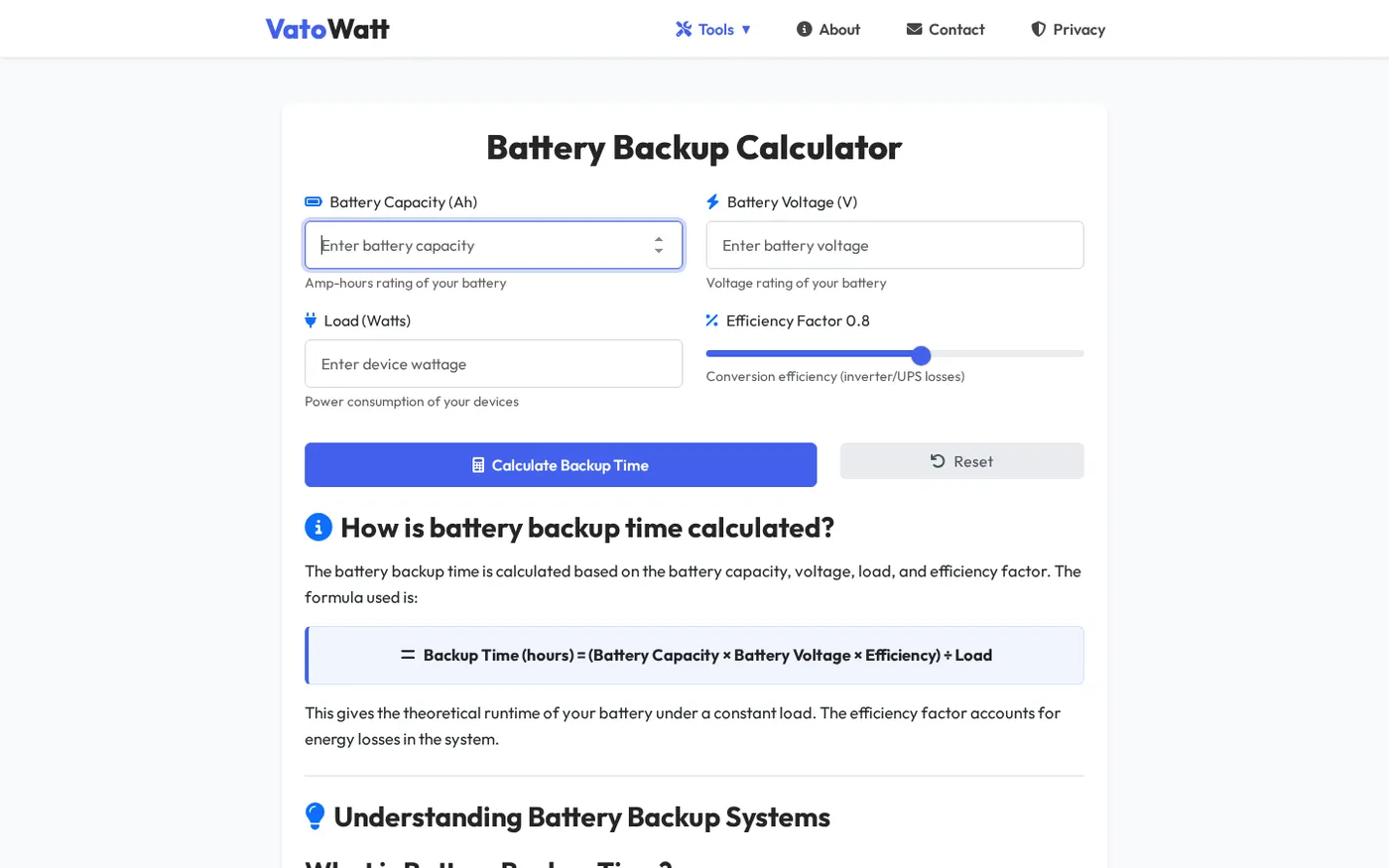
- Put the selected Ah, voltage and actual load into the Battery Backup Calculator and compare the runtime with your target.
- If the result looks surprisingly small, check that you did not omit efficiency or DoD. If it looks surprisingly large, check whether your load includes appliances you do not need during a power cut.
Common mistakes to avoid
- Using the inverter’s VA number as though it were battery Ah.
- Adding every appliance in the home even though they will not run together.
- Dividing watt-hours by 12 V when the inverter actually uses a 24 V bank.
- Treating a 150 Ah label as 150 Ah of fully usable AC energy.
- Forgetting fridge, pump or cooler starting surge when choosing the inverter.
FAQ
Is a 150 Ah battery enough for a home inverter?
It can be enough for a smaller load or a shorter outage. With the example assumptions here, a 150 Ah, 12 V battery runs a 400 W load for about 1.91 hours; a lower load will run longer. Calculate the appliances you actually want to use before choosing it.
Should I choose a 150 Ah or 200 Ah battery?
At the same voltage and load, 200 Ah stores one-third more nominal energy than 150 Ah. In the 400 W example, the estimated runtime is about 2.55 hours for 200 Ah versus 1.91 hours for 150 Ah, using 85% efficiency and 50% DoD.
How many Ah battery is required for 8 hours?
For a 400 W load, the formula gives about 628 Ah at 12 V or 314 Ah at 24 V when using 85% efficiency and 50% DoD. Your answer will be lower for a smaller load and higher for a larger load, so do not use 628 Ah as a general home rule.
Can I use any Ah battery with my inverter?
No. The bank voltage, battery chemistry, charging profile, continuous current and physical connection requirements must match the inverter and battery documentation. A higher Ah number does not correct an incompatible voltage or inverter rating.
Does inverter VA decide the battery Ah?
Not by itself. VA helps describe how much load the inverter can support at once, while Ah describes battery capacity and therefore backup duration. You need both the simultaneous load and the target hours to calculate the battery size.