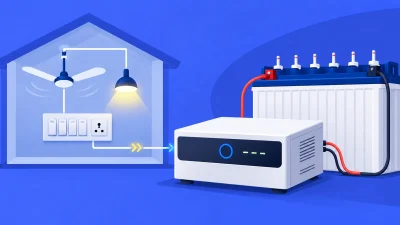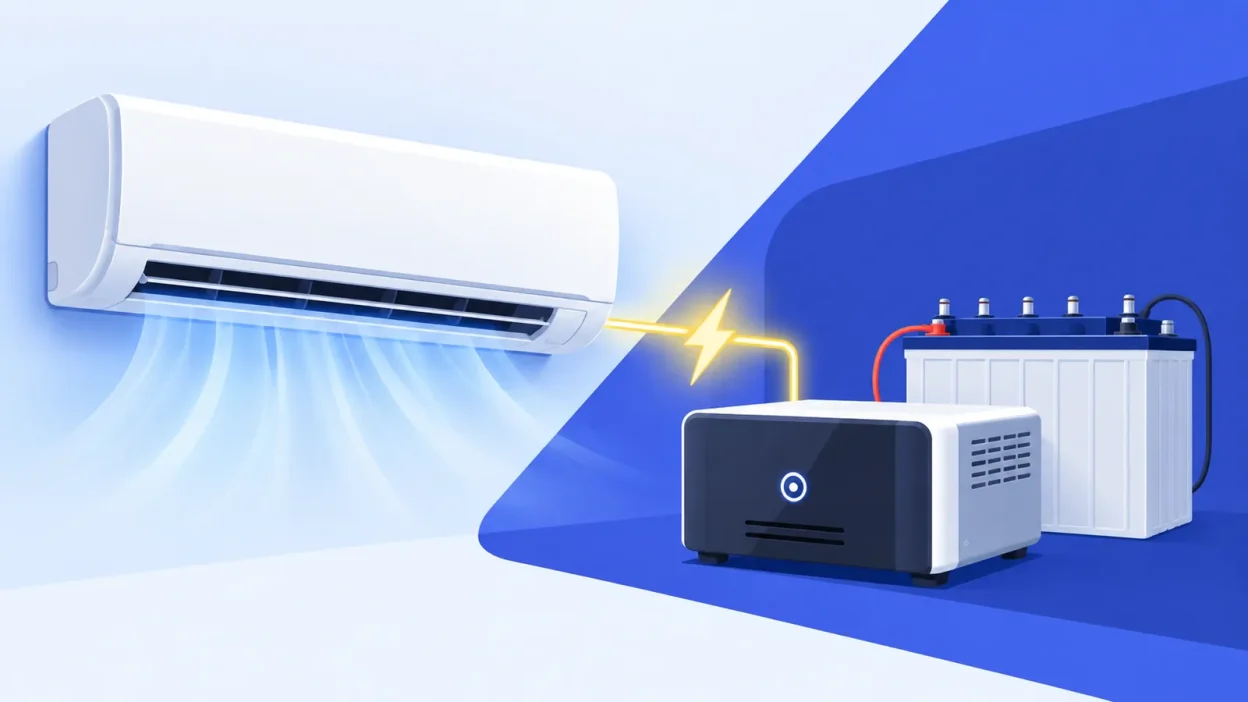
An inverter for AC must be sized from the air conditioner’s actual power consumption, not just its 1.5-ton cooling label. Read the BEE label, add the other appliances that will run, check compressor startup power and then size the battery for the hours you need.
Short answer: what size inverter does a 1.5-ton AC need?
There is no single inverter size for every 1.5-ton AC. The BEE label gives you two different numbers: cooling capacity and power consumption. Use the power-consumption number for the running load, then check the inverter’s continuous and peak ratings.
This table shows the maths for simple planning examples. These are not universal AC wattages; replace each example with the power shown on your own AC’s label or technical sheet.
| AC size | Example power input | Running VA at PF 0.8 | What the number means |
|---|---|---|---|
| 1 ton | 1,000 W | 1,250 VA | Add other loads and startup headroom |
| 1.5 ton | 1,500 W | 1,875 VA | AC alone, before surge or other appliances |
| 2 ton | 2,000 W | 2,500 VA | A planning example, not a model specification |
For the 1.5-ton example, a 2,000 VA inverter is only just above the 1,875 VA AC-only figure; once you add other loads and normal sizing margin, it may be too small. A 2.5 kVA-class inverter may pass the continuous-load check for this example, but its peak rating must also handle the compressor and any appliances starting at the same time.
What you need before sizing
Collect these numbers before choosing an inverter:
- The AC’s Power Consumption (W) from its BEE label or manufacturer specification. Do not use Cooling Capacity (W) as the electrical load.
- The AC type and compressor information. A variable-speed AC can change its input power as the room cools; a fixed-speed compressor has a different starting pattern.
- The wattage of every other appliance you want during an outage: fans, LED bulbs, router, television, refrigerator or pump.
- Your desired backup time, such as 1 hour, 4 hours or 8 hours.
- The battery system voltage you are considering: 12 V, 24 V or 48 V.
The official BEE room-air-conditioner label rules list cooling capacity and power consumption as separate label particulars. BEE’s Standards and Labelling programme also explains how appliance labels help consumers compare energy performance.
Step 1: Read the AC label correctly
Why this matters: “1.5 ton” describes the cooling capacity. It does not mean that the AC always draws exactly 1,500 W from the inverter.
Find the model label, manual or technical data sheet. Write down the input power in watts. If the specification gives a range, use the higher rated input for the first inverter check. Also note whether the AC has a variable-speed compressor.
For example, suppose your label says 1,500 W power consumption. That is the number used in the rest of this worked example. It is an assumption for learning the calculation, not a claim about every 1.5-ton AC.
If your AC label lists only cooling capacity or you cannot identify the input-power figure, pause here and find the exact model specification. Guessing from tonnage can lead to an inverter that is too small.
Step 2: Add the running load
Why this matters: The AC will not be the only thing connected to the inverter. Your inverter must supply the combined load when all selected appliances are on.
Write the running watts for each appliance and add them:
| Appliance | Running load in this example |
|---|---|
| 1.5-ton AC | 1,500 W |
| Fans, lights and Wi-Fi router | 300 W |
| Total continuous load | 1,800 W |
Use your own numbers. A fan or light that you plan to leave off during a power cut should not be included. A refrigerator, pump or other motor that may start automatically should be included even if it does not run continuously.
You can use the Power Consumption Calculator to estimate the wattage and daily energy of the appliances in your home. For inverter sizing, the important starting point is the set of appliances that may run at the same time.
Step 3: Allow for compressor startup surge
Why this matters: An AC compressor can need a short burst of power when it starts. An inverter can have enough continuous watts but still trip if its peak rating is too low.
Use this screening calculation:
AC startup load = AC running watts × startup multiplierIf you use the calculator’s 3x planning option for the 1,500 W example:
AC startup load = 1,500 W × 3 = 4,500 W
Combined peak screening load = 4,500 W + 300 W = 4,800 W
The 3x value is a planning input, not a measurement of your AC. An inverter AC, a fixed-speed AC and different models can have different starting behaviour. Check the AC and inverter manuals for their actual starting or peak requirements where available.
When comparing an inverter, check both values:
- Continuous rating: must cover the combined running load.
- Peak or surge rating: must cover the compressor-start estimate and other devices that may start together.
Do not judge the inverter by its VA label alone. Look for the continuous watt rating, peak watt or VA rating, output waveform requirement and stated compatibility with motor or compressor loads.
Step 4: Convert watts to VA
Why this matters: Inverter capacity is commonly advertised in VA, while appliance labels show watts. Power factor connects the two.
Use:
VA = watts ÷ power factorWith VatoWatt’s Indian planning default of PF 0.8, the 1.5-ton AC example becomes:
AC only:       1,500 W ÷ 0.8 = 1,875 VA
AC plus 300 W: 1,800 W ÷ 0.8 = 2,250 VA
So this example needs at least 2,250 VA of continuous capacity before any extra margin. The next available inverter size must be above that calculated requirement, and its peak specification must also pass the startup check from Step 3.
If your AC label says 1,200 W, the same calculation is 1,500 VA for the AC alone. If it says 1,800 W, it is 2,250 VA before other loads. This is why a model-specific label beats a generic “1.5-ton AC wattage” chart.
Step 5: Size the battery bank for backup hours
Why this matters: A large inverter can run a load, but it cannot create battery energy. AC backup becomes battery-heavy as the required hours increase.
For a simple estimate using the inverter calculator’s defaults, use:
Battery Ah = load watts × backup hours
             ÷ (battery volts × inverter efficiency × usable discharge fraction)
The defaults are 85% inverter efficiency and 50% maximum depth of discharge. For the 1,500 W AC alone on a 24 V system for 4 hours:
Battery Ah = 1,500 × 4 ÷ (24 × 0.85 × 0.50)
           = 6,000 ÷ 10.2
           = 588.24 Ah at 24 V
That is a large bank. With the same 4-hour target on 48 V:
Battery Ah = 1,500 × 4 ÷ (48 × 0.85 × 0.50)
           = 294.12 Ah at 48 V
The watt-hours are similar, but the Ah number changes with system voltage. Do not compare a 24 V battery bank and a 48 V battery bank by Ah alone.
Here is a runtime example using a 24 V, 200 Ah bank:
Usable AC energy = 24 × 200 × 0.50 × 0.85
                 = 2,040 Wh

Runtime for 1,500 W AC = 2,040 ÷ 1,500
                        = 1.36 hours, or about 1 hour 22 minutes
With the extra 300 W load, the same estimate is 2,040 ÷ 1,800 = 1.13 hours, or about 1 hour 8 minutes. Actual runtime varies with battery type, age, temperature, discharge rate and changing AC load. Treat the result as a sizing estimate, not a guaranteed runtime.
For a second calculation, the Battery Backup Calculator uses battery Ah, voltage, load watts and an efficiency factor to estimate runtime. Enter the battery bank’s actual voltage and capacity, not the rating of only one battery in a series bank.
Step 6: Check the numbers in the calculator
Why this matters: A calculator makes it easier to include every appliance and change the backup time without losing track of units.
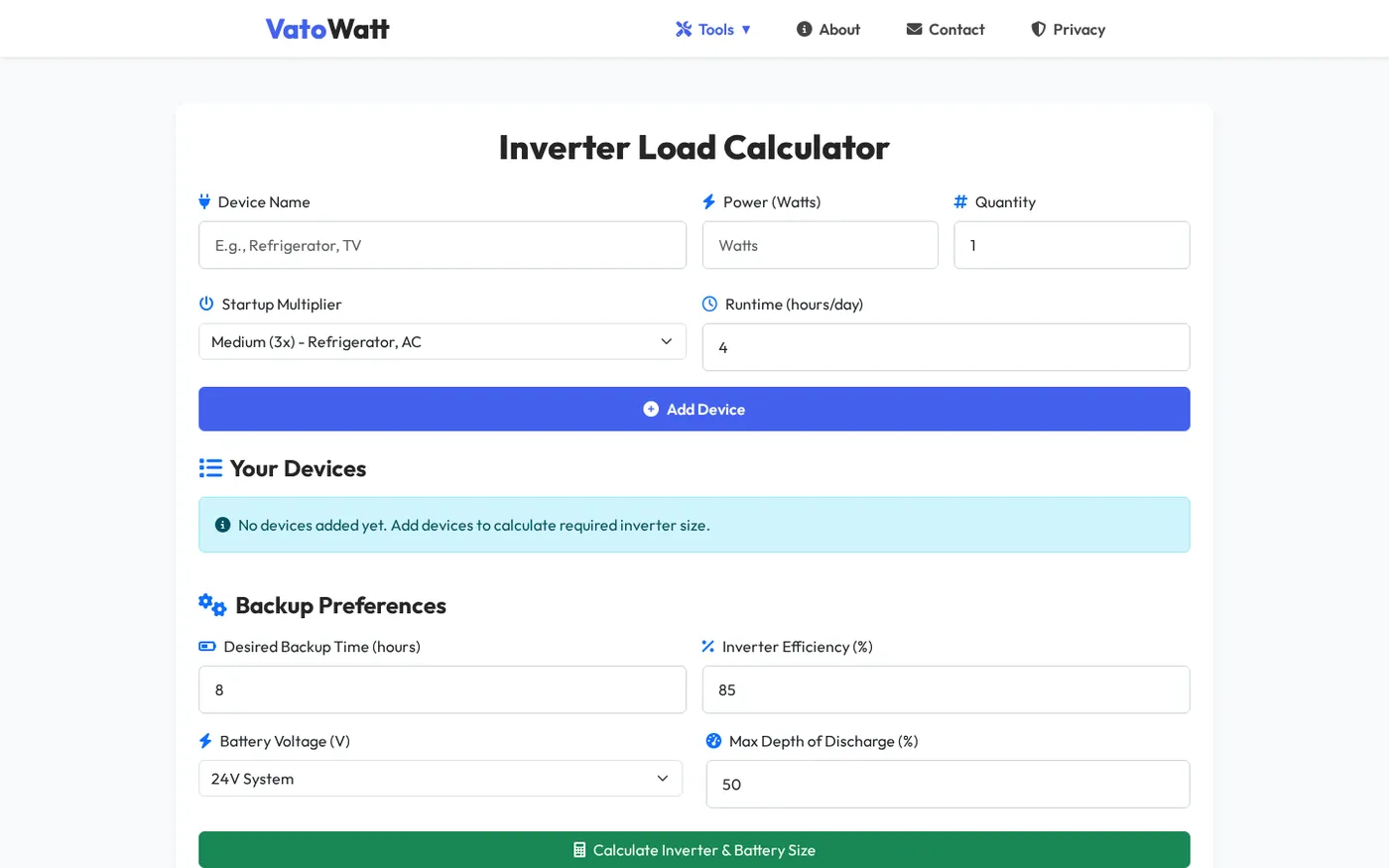
Open the Inverter Load Calculator and enter:
- The AC’s labelled input watts, quantity 1 and the number of hours you expect it to run.
- The startup multiplier as a planning value, then change it if the AC manufacturer gives a better figure.
- Every fan, light, router, refrigerator or other appliance that may run at the same time.
- Your desired backup time. If you want 4 hours, replace the default with 4; do not leave 8 hours unless that is your real target.
- Inverter efficiency of 85%, the battery voltage, and maximum depth of discharge of 50% for the worked example.
The result should show continuous power, startup power, inverter VA and battery Ah. Compare those results with the exact inverter’s data sheet. If the calculator result and the manufacturer’s rating use different units, convert them before comparing.
Verify the recommendation before buying
Use this final checklist:
- The AC input watts came from the exact model label or manual.
- The inverter’s continuous watt and VA ratings exceed the combined running load.
- The inverter’s peak rating covers the compressor-start estimate.
- The output voltage and waveform meet the AC and inverter manufacturer requirements.
- The battery bank voltage matches the inverter, and its Ah capacity meets the desired hours.
- The system is suitable for India’s 230 V, 50 Hz supply and is installed by a licensed electrician.
- You have not counted the AC’s cooling-capacity watts as its electrical input watts.
Common mistakes and troubleshooting
| Problem | Likely reason | What to check |
|---|---|---|
| The inverter trips as the AC starts | Peak rating is too low or another motor starts with it | Check the AC’s starting requirement and inverter peak rating |
| The inverter runs but backup ends quickly | Load, hours or battery capacity was underestimated | Re-enter all simultaneous loads and recalculate Ah |
| A 24 V system appears to have the same Ah as a 12 V system | Ah was compared without voltage | Compare watt-hours: volts × Ah |
| The calculated inverter looks too small | Cooling capacity was used instead of power consumption | Re-read the AC label and use input watts |
| Runtime changes during the day | Variable-speed AC input and room conditions change | Size from rated input, then treat runtime as an estimate |
Never open the inverter or alter live mains connections to solve a trip or startup problem. Use the product manuals and a licensed electrician for diagnosis and installation.
When is running an AC on an inverter practical?
It can be practical for a short outage when you have a correctly sized inverter and enough battery energy. The maths becomes less attractive when you want several hours of cooling: the 1,500 W example needs about 588 Ah at 24 V for 4 hours under the stated assumptions, before adding fans, lights or a refrigerator.
If your priority is a longer backup, compare two scenarios in the calculator: AC only and essential loads only. This shows the battery trade-off clearly and lets you choose a realistic backup time without assuming that one 12 V battery will run everything.
FAQ
Can a 1.5-ton AC run on an inverter?
Yes, if the inverter’s continuous output, peak rating, output requirements and battery bank all match the AC’s specification. The AC’s 1.5-ton label alone does not prove that a particular inverter will start it.
What size inverter is needed for a 1.5-ton AC?
Read the AC’s input watts first. If the label says 1,500 W, the AC alone is 1,875 VA at PF 0.8; with another 300 W of appliances, the continuous calculation becomes 2,250 VA. Check the inverter’s peak rating separately for compressor startup.
How many batteries are needed for a 1.5-ton AC?
There is no fixed battery count because the answer depends on voltage, Ah capacity, AC watts and backup hours. For example, a 24 V, 200 Ah bank gives an estimated 1.36 hours for a 1,500 W AC under 85% efficiency and 50% discharge assumptions.
How long will a battery run a 1.5-ton AC?
Use hours = battery Ah × battery V × efficiency ÷ load W for a quick runtime estimate, then apply the usable discharge limit you plan to follow. Enter the exact battery and AC numbers in the Battery Backup Calculator because an inverter AC’s load can change while it runs.