An inverter for home with battery 24 hours backup is possible, but only after you define the load in watts and the energy it will use. A small essentials-only load can be designed on paper; a full home running fans, fridge, cooler, TV and other appliances for a whole day needs a much larger battery bank, solar charging or both.
Is 24 hours backup possible? Short answer
Yes, but “24 hours” is not an inverter size. It is a battery-energy target. The inverter must handle the appliances running at the same time, while the battery must store enough watt-hours for the number of hours you want.
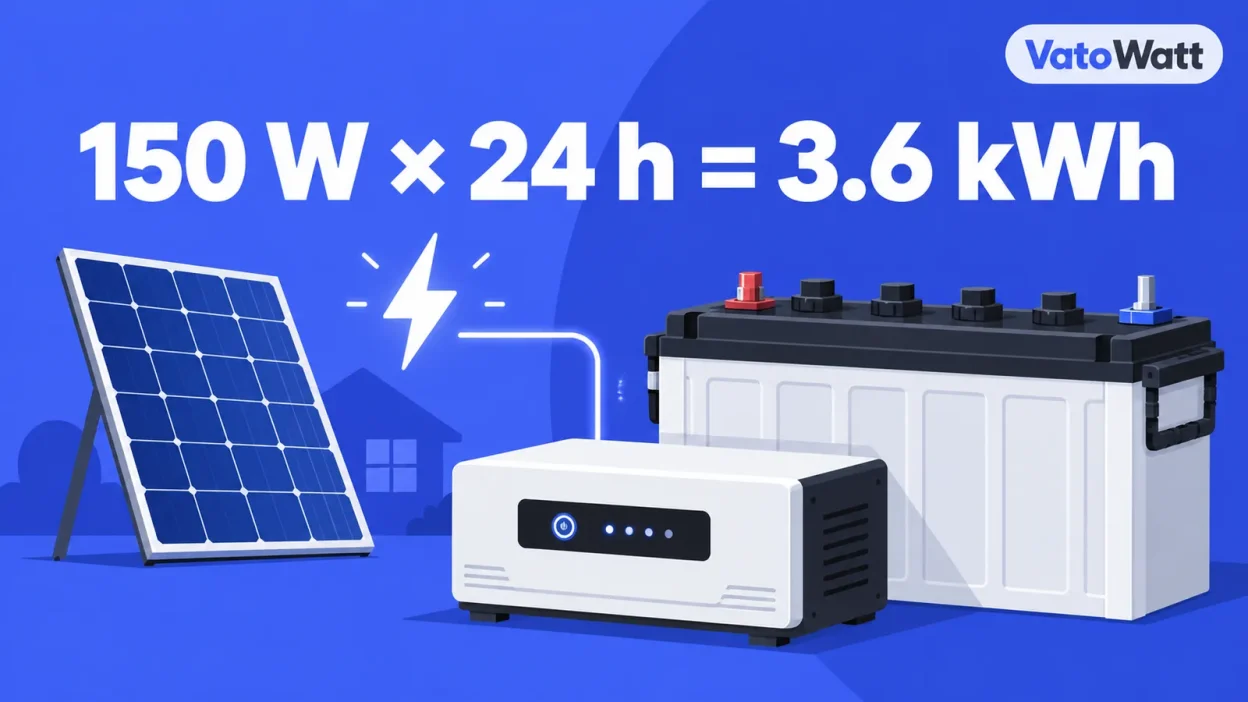
For example, 150 W running continuously for 24 hours uses:
150 W × 24 h = 3,600 Wh = 3.6 kWhThat is an essentials load, not a full-home load. A 600 W average load uses 600 × 24 = 14,400 Wh, or 14.4 kWh, before allowing for conversion losses and the battery capacity you keep in reserve.
Storage systems are described by both energy capacity and power capacity: energy is how much they can store, while power is how much they can release at a time. The US Department of Energy’s storage overview explains the same distinction for battery and solar systems.
The honest answer is therefore:
- 24 hours for essential lights, fans and Wi-Fi: possible with a carefully sized bank.
- 24 hours for a medium home load: possible on paper, but the battery bank becomes large and costly in space, weight and charging demand.
- 24 hours for a full home including air conditioning: not a normal small-inverter job. It needs a properly designed high-energy system, usually with solar or another charging source.
Essentials-only load: the numbers
Start with the appliances you genuinely need during a long outage. Do not use the number of bedrooms or the inverter’s VA label as a substitute for a load list.
Here is a worked 150 W essentials load:
| Appliance | Quantity | Example watts each | Total watts |
|---|---|---|---|
| Ceiling fan | 2 | 60 W | 120 W |
| LED bulb | 2 | 10 W | 20 W |
| Wi-Fi router | 1 | 10 W | 10 W |
| Running load | 150 W |
The wattages are examples. Read the rating label or manual for your own appliances. A fan may use more or less than the example, and a fridge, cooler or pump adds both running load and starting-surge requirements.
At 150 W, the load uses 3.6 kWh if it runs continuously for 24 hours. If the fans run only 12 hours and the lights only 6 hours, the daily energy is lower. That is why an appliance-by-appliance list with operating hours often gives a more useful answer than assuming every device is on all day.
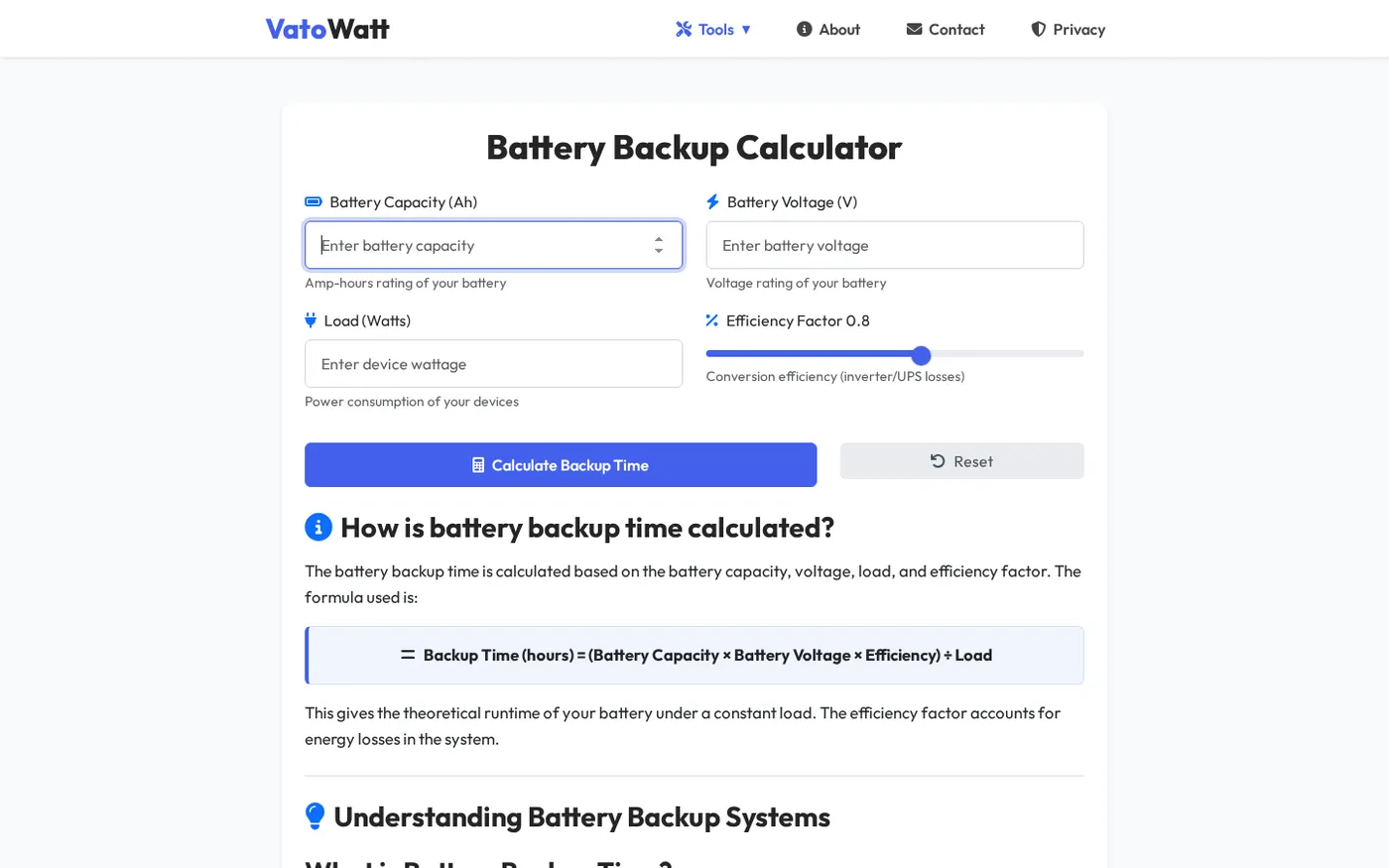
For a first runtime estimate, put the battery Ah, bank voltage and total load into the Battery Backup Calculator. Its default estimate uses an efficiency factor of 0.8 and shows the result in hours and minutes.
Battery Ah needed for 24 hours backup
For a conservative battery-bank sizing estimate, use:
Required battery Ah = Load (W) × Backup time (h)
                     ───────────────────────────────
                     Battery voltage (V) × 0.85 × 0.50
Here, 0.85 is the inverter-efficiency assumption and 0.50 is the planned depth of discharge. The calculation keeps half of the nominal battery capacity as reserve instead of treating every printed Ah as usable AC energy.
For the 150 W essentials load and 24 hours:
Energy needed at the AC load = 150 W × 24 h = 3,600 Wh

At 12 V:
Required Ah = 3,600 ÷ (12 × 0.85 × 0.50)
            = 3,600 ÷ 5.1
            = 705.88 Ah
Round only at the end: the design result is 706 Ah at 12 V.
At 24 V:
Required Ah = 3,600 ÷ (24 × 0.85 × 0.50)
            = 3,600 ÷ 10.2
            = 352.94 Ah
The design result is 353 Ah at 24 V. The higher voltage reduces the Ah number, but it does not remove the 3.6 kWh energy requirement.
Depth of discharge is a design limit, not a promise that every battery delivers the same amount of energy. Battery University notes that discharge conventions vary and that avoiding full discharges can reduce battery stress. Read its explanation of discharge and DoD before applying a battery manufacturer’s limit.
What does that mean in common battery units?
Suppose you are using 12 V, 150 Ah batteries only as a maths illustration:
- At 12 V,
706 ÷ 150 = 4.71, so the rounded requirement is five 150 Ah units for the 150 W, 24-hour design. - At 24 V, the bank needs 353 Ah. Two 12 V batteries in series make a 24 V, 150 Ah string, so three such strings give 24 V and 450 Ah: six 150 Ah units in this example.
Those are capacity calculations, not connection instructions or a universal product recommendation. The inverter must support the bank voltage, the battery bank must be configured as specified by its manufacturer, and the physical installation must be assessed by a licensed electrician.
The US Department of Energy’s lead-acid primer explains that Ah ratings are measured under specified discharge conditions, that capacity changes with discharge rate, and that series connections raise voltage while parallel connections raise capacity. See the battery-capacity and connection guidance.
How much battery for a bigger home load?
The fastest way to see the effect of load is to hold the backup target at 24 hours and change only the average watts. The table uses 85% inverter efficiency and 50% DoD, matching the sizing assumptions above.
| Average load | Energy for 24 h | Required at 12 V | Required at 24 V |
|---|---|---|---|
| 150 W | 3.6 kWh | 706 Ah | 353 Ah |
| 300 W | 7.2 kWh | 1,412 Ah | 706 Ah |
| 500 W | 12.0 kWh | 2,353 Ah | 1,177 Ah |
| 800 W | 19.2 kWh | 3,765 Ah | 1,883 Ah |
This is why a seller’s “24-hour backup” statement is incomplete without the load. A 24-hour promise at 150 W describes 3.6 kWh of appliance energy; at 800 W it describes 19.2 kWh. The inverter also needs enough continuous output and surge capacity for the appliances, especially compressors and motors.
Do not add every appliance in the house automatically. A fridge may cycle rather than draw its rated running watts for the full day, while a cooler or pump may run for selected hours. Enter each appliance, quantity and hours in the Inverter Load Calculator to separate running load from the daily energy pattern.
Why full-home 24-hour backup needs solar or lithium
A battery-only system has to store the energy before the outage starts. For the 150 W example, the conservative design already needs 3.6 kWh of load energy and a nominal battery bank much larger than 3.6 kWh because of efficiency and the reserve for DoD.
Solar changes the question from “How much battery can I carry?” to “How much energy can I produce and store each day?” Using VatoWatt’s solar assumptions of a 400 W panel, 4.5 peak sun hours and 80% system efficiency:
Daily energy from one 400 W panel
= 0.4 kW × 4.5 h × 0.80
= 1.44 kWh per day
For the 3.6 kWh essentials load:
3.6 kWh ÷ 1.44 kWh per panel = 2.5 panelsRound up to three 400 W panels in this simplified production estimate. This does not prove that three panels will cover every season or every battery-charging condition; shading, roof direction, weather, charge-controller limits and system losses still matter. Run your own daily energy in the Solar Panel Calculator.
For a 600 W average full-home load, the same calculation gives 14.4 kWh per day. At 1.44 kWh per 400 W panel, that is 10 panels in the simplified estimate. The battery still has to cover the night and cloudy periods, and the inverter still has to start the connected appliances.
Lithium systems are often specified in usable kWh rather than only Ah, which makes energy comparisons easier. Do not choose a battery from chemistry name alone: compare usable energy, nominal voltage, continuous discharge power, permitted DoD, battery-management system and inverter compatibility. The US Department of Energy’s energy-storage overview also separates stored energy from deliverable power, which is the key check here.
Battery backup calculator: run your own numbers
The two formulas answer slightly different planning questions:
- The Battery Backup Calculator estimates runtime from Ah, voltage, load and its 0.8 efficiency factor.
- The sizing formula above works backwards from a target number of hours and deliberately includes 85% inverter efficiency and 50% DoD.
For example, a 12 V, 150 Ah battery with a 150 W load gives:
Estimated runtime = (150 Ah × 12 V × 0.8) ÷ 150 W
                  = 1,440 Wh ÷ 150 W
                  = 9.6 hours
                  = 9 hours 36 minutes
That result is a simple calculator estimate. The 24-hour sizing example uses a 50% DoD reserve, so it asks for a much larger nominal bank. Use the battery’s own datasheet, the inverter’s efficiency and the permitted discharge limit when you move from an estimate to equipment selection.
Check these five items before choosing an inverter
- Running watts: add the appliances that will operate together.
- Starting surge: include the surge factor for a fridge, pump, cooler or other motor.
- Backup energy: multiply the expected watts by the hours, including realistic appliance run time.
- Bank voltage: use the 12 V, 24 V or 48 V voltage supported by the inverter.
- Battery limits: check Ah or usable kWh, DoD, discharge rate, temperature range and age-related capacity assumptions.
Common mistakes
- Treating inverter VA as though it were battery Ah.
- Calling a 150 Ah battery “24-hour backup” without stating the load.
- Using 12 V in the formula for an inverter that requires a 24 V or 48 V bank.
- Assuming every appliance runs continuously for 24 hours when the real schedule is intermittent.
- Ignoring fridge, pump or cooler starting surge because the running watts look small.
- Treating nominal battery energy as fully usable AC energy.
- Adding solar panel wattage without checking daily energy, charge-controller limits and the battery’s charging requirements.
FAQ
What size inverter gives 24 hours backup at home?
The inverter size is based on the appliances running together, not on the 24-hour duration. Add their running watts, check motor starting surge, and then size the battery separately for the required watt-hours.
How many batteries do I need for 24 hours backup?
There is no single number without the load. For a 150 W essentials load, the worked estimate needs about 706 Ah at 12 V or 353 Ah at 24 V using 85% efficiency and 50% DoD; a 300 W load needs twice those Ah values.
Can a 150 Ah battery give 24 hours backup?
Only with a much smaller average load than the 150 W example, or with a different backup pattern where appliances run for limited hours. Under the Battery Backup Calculator’s simple 0.8 estimate, a 12 V, 150 Ah battery at 150 W is about 9 hours 36 minutes, not 24 hours.
Is solar needed for 24-hour inverter backup?
Not always, but solar can reduce how much energy must be stored in the battery before the outage and can recharge the system during the day. For the worked 150 W continuous load, the simplified 400 W-panel calculation gives three panels to produce about 3.6 kWh per day under the stated assumptions.
Is a 24 V battery bank better than 12 V for long backup?
A 24 V bank uses fewer Ah for the same stored energy, so it can be more practical as the load grows. It is only suitable when the inverter and battery configuration support 24 V; the higher voltage does not reduce the total watt-hours required.
Related calculators
- VA to Watt Converter — convert an inverter or UPS VA rating into watts.
- Watt to VA Converter — find the VA rating for a watt load.
- Inverter Load Calculator — total appliance watts and check surge factors.
- Battery Backup Calculator — estimate runtime from Ah, voltage and watts.
- Solar Panel Calculator — estimate panels from daily energy use.
- Power Consumption Calculator — estimate appliance units and daily energy.