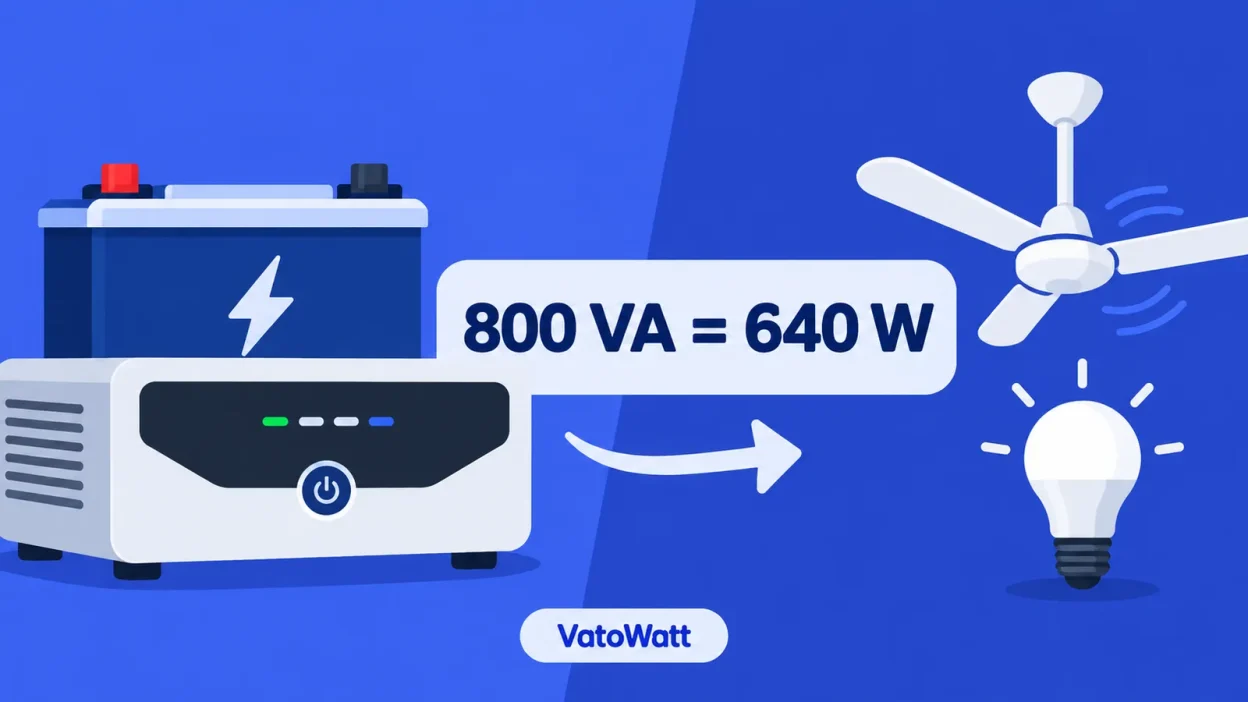
For 800va to watt conversion, an 800 VA inverter or UPS gives 640 W at a power factor of 0.8. That is the usual starting estimate for a mixed home load, but the exact usable wattage is the watt rating printed on your inverter, so check it before connecting appliances.
800 VA to watts: the quick answer
Use this formula:
Watts = VA × power factorFor an 800 VA unit using PF 0.8:
800 VA × 0.8 = 640 WSo, 800 VA = 640 W at PF 0.8. The result is not 800 W because VA is apparent power, while watts are real power. Eaton explains that apparent power combines real and reactive power, and that the power factor is needed to convert between VA and watts. See its VA versus watts guide for the electrical relationship.
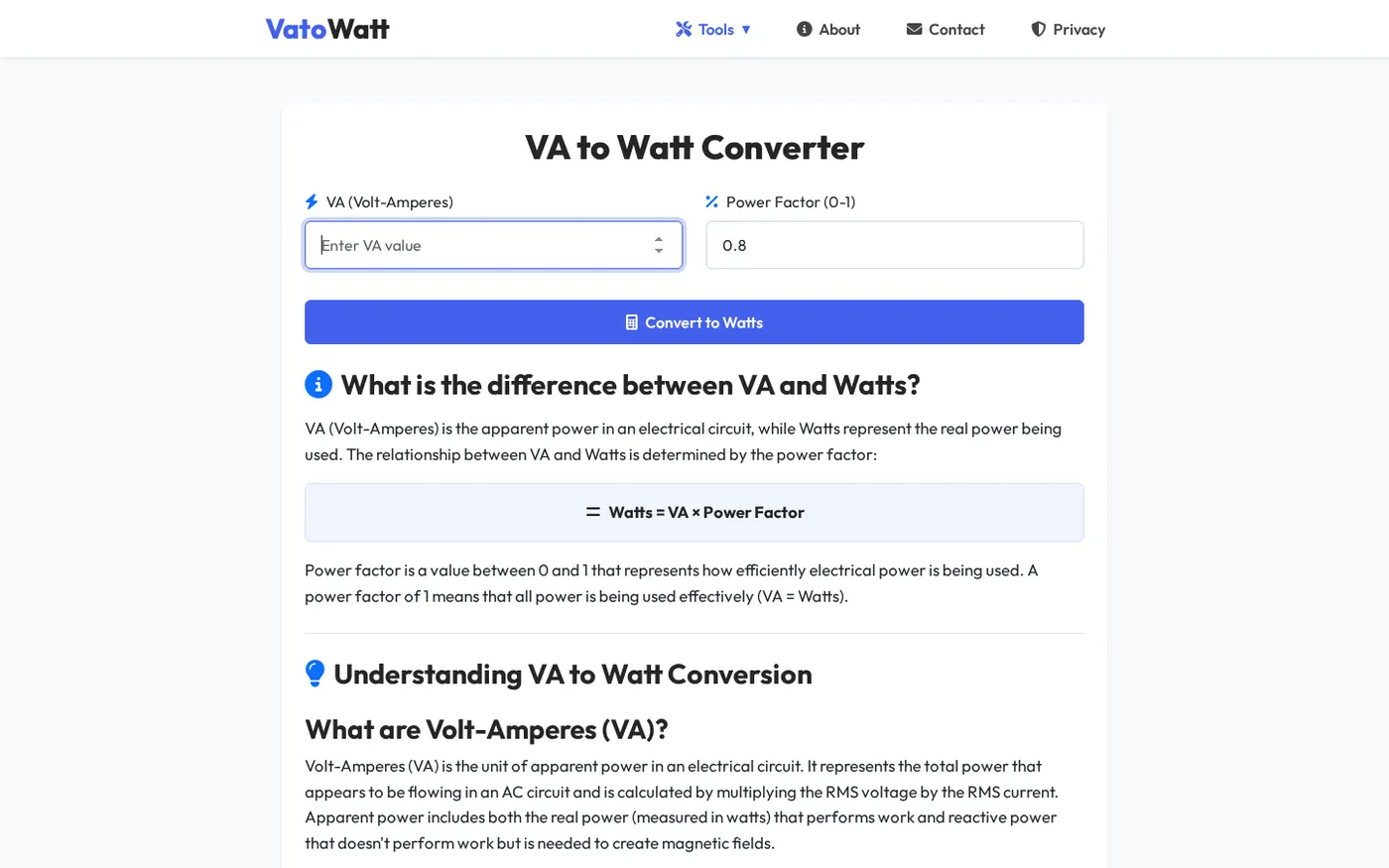
You can recheck the number with the free VA to Watt Converter. Enter 800 as VA and keep the PF at 0.8 unless your inverter’s specification gives a different value.
The formula changes with power factor
Power factor, or PF, is the ratio of useful real power to apparent power. Fluke writes it as PF = W/VA, so the reverse conversion is W = VA × PF. A higher PF gives more watts from the same VA rating; a lower PF gives fewer.
Here is the result for an 800 VA rating at several PF values:
| Power factor | Calculation | Real power |
|---|---|---|
| 0.6 | 800 × 0.6 | 480 W |
| 0.7 | 800 × 0.7 | 560 W |
| 0.8 | 800 × 0.8 | 640 W |
| 0.9 | 800 × 0.9 | 720 W |
| 1.0 | 800 × 1.0 | 800 W |
Use the inverter’s own watt specification when it is available. If the label only shows VA and you do not know the PF, 0.8 is a practical estimate for this calculator, not a promise that every 800 VA model delivers exactly 640 W.
What an 800 VA inverter can run in a 1BHK
An 800 VA unit can suit a modest 1BHK backup load when the running watts stay comfortably below 640 W and motor starting demand is checked separately. The following is an example, not a replacement for the watt labels on your appliances:
| Appliance | Quantity | Example watts each | Running total |
|---|---|---|---|
| Ceiling fan | 2 | 60 W | 120 W |
| LED bulb | 4 | 10 W | 40 W |
| Wi-Fi router | 1 | 12 W | 12 W |
| Television | 1 | 80 W | 80 W |
| Refrigerator, running estimate | 1 | 150 W | 150 W |
| Total | 402 W |
At 402 W, the example load is below the estimated 640 W real-power limit. Its apparent load at PF 0.8 is:
402 W ÷ 0.8 = 502.5 VAThat leaves about 297.5 VA below the 800 VA nameplate in this simplified calculation. A refrigerator still has a compressor, so its starting demand can be higher than its running watts. Do not add a fridge, cooler, pump or other motor only by adding the number printed on its running label; check the inverter’s surge specification and keep some headroom.
For a different appliance list, use the Inverter Load Calculator. Enter each appliance’s watts and quantity, then review both the running load and surge factor.
Backup time with 100 Ah and 150 Ah batteries
VA-to-watt conversion tells you whether the inverter can carry the load. It does not tell you how long the battery will last. For a simple estimate, VatoWatt uses:
Backup hours = battery Ah × battery voltage × battery efficiency ÷ load wattsThe calculator’s default battery efficiency is 0.8. This is an estimate; actual runtime changes with battery condition, temperature, discharge rate, inverter draw and the load. Victron’s inverter manual similarly starts with the equipment’s watt-hours and adds inverter losses when calculating battery capacity.
Example at a 300 W load
Assume a 12 V battery and a steady 300 W load:
| Battery | Calculation | Estimated backup |
|---|---|---|
| 100 Ah, 12 V | 100 × 12 × 0.8 ÷ 300 | 3.2 hours |
| 150 Ah, 12 V | 150 × 12 × 0.8 ÷ 300 | 4.8 hours |
The 100 Ah result is 3 hours 12 minutes, and the 150 Ah result is 4 hours 48 minutes in this simplified model. These are not guaranteed cut-off times. A battery should not be selected from Ah alone: confirm its voltage, the inverter’s battery-bank requirement and the manufacturer’s specifications.
If you run the full 402 W example load instead, the same estimate becomes about 2.4 hours for 100 Ah and 3.6 hours for 150 Ah:
100 × 12 × 0.8 ÷ 402 = 2.39 hours
150 × 12 × 0.8 ÷ 402 = 3.58 hours
Use the Battery Backup Calculator to substitute your actual Ah, voltage and load. You can also read the worked battery backup time formula for more examples.
When is 800 VA too small?
An 800 VA inverter is too small for a planned load when the total demand exceeds its continuous VA or watt limit, or when startup surge pushes a motor beyond its peak rating. It may also be the wrong size if you expect to add a cooler, pump, microwave, desktop computer or several more appliances during a power cut.
Check these numbers before deciding:
- Add the running watts of every appliance you want on backup.
- Convert that watt total to VA with
VA = watts ÷ PF. - Compare the result with the inverter’s continuous VA rating.
- Compare motor startup demand with its surge rating.
- Check the inverter’s separate maximum watt rating; never use the VA number as a substitute for it.
For example, a 700 W load at PF 0.8 needs:
700 W ÷ 0.8 = 875 VAThat is already above 800 VA before allowing for starting demand or future additions. Choose a suitably larger system using the appliance list rather than rounding this result down.
Common mistakes with 800 VA ratings
Treating VA and watts as identical: They match only when PF is 1.0. At PF 0.8, 800 VA is 640 W.
Confusing watts with watt-hours: Watts describe the load at a moment. Watt-hours describe energy used over time, which is why battery backup needs the battery voltage, Ah and hours.
Ignoring the appliance label: The 0.8 PF value is a default estimate. Use a stated PF or watt rating from the equipment documentation when you have it.
Using all 640 W continuously: The conversion gives a calculated real-power limit, not a recommendation to operate at the edge. Leave room for starting currents and check the specific inverter’s manual.
Choosing a battery from VA alone: Battery runtime depends on watts, voltage, capacity and losses. Two appliances with a similar VA load can need different battery capacity if their real watt loads differ.
FAQ
How many watts is 800 VA at power factor 0.8?
800 VA at PF 0.8 is 640 W. Calculate it as 800 × 0.8 = 640 W.
Is an 800 VA inverter enough for a home?
It can be suitable for a modest 1BHK load such as fans, lights, a router and television, if the total running load and startup demand fit the model’s limits. Check the inverter’s watt rating, continuous VA rating and surge rating before connecting a refrigerator or other motor load.
How long will a 100 Ah battery last with an 800 VA inverter?
There is no single runtime from the inverter’s VA rating. For example, a 12 V 100 Ah battery at 80% usable efficiency gives about 3.2 hours for a 300 W load, before other real-world losses and cut-off limits.
What is the difference between 800 VA and 800 W?
800 VA is apparent power, while 800 W is real power. An 800 VA unit produces 800 W only at PF 1.0; at PF 0.8, the equivalent real power is 640 W.
How do I calculate the VA needed for a watt load?
Divide watts by power factor: VA = W ÷ PF. A 700 W load at PF 0.8 needs 875 VA before you account for surge or extra headroom.
Related calculators
- VA to Watt Converter
- Watt to VA Converter
- Inverter Load Calculator
- Battery Backup Calculator
- Solar Panel Calculator
- Power Consumption Calculator
DONE 800-va-to-watts words=989