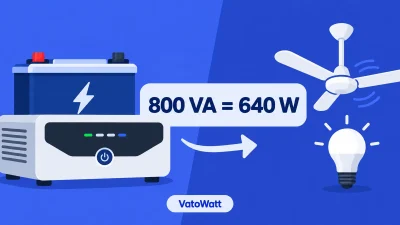
VA vs watts becomes important when you read an inverter, UPS or generator label and see two different ways to describe its capacity. Watts describe real power used by your appliances, while VA describes apparent power that the electrical system must supply.
The link between them is the power factor (PF). Once you know the PF, you can convert VA to watts, convert watts back to VA, and make a more sensible comparison between an appliance load and an inverter rating.
VA vs watts in one line
The short answer is:
Watts = VA × power factor
And the reverse is:
VA = watts ÷ power factor
VA means volt-amperes. It is the product of the RMS voltage and RMS current in an AC circuit, without first accounting for the timing relationship between them. Watts, also called real or active power, represent the part that is actually consumed to produce light, heat, movement or useful electronic work.
Power factor is written as a decimal between 0 and 1 for this type of calculation. At PF 1.0, the VA and watt numbers are numerically the same. At PF 0.8, only 80% of the VA number becomes watts:
| Rating | PF | Calculation | Real power |
|---|---|---|---|
| 1,000 VA | 1.0 | 1,000 × 1.0 | 1,000 W |
| 1,000 VA | 0.9 | 1,000 × 0.9 | 900 W |
| 1,000 VA | 0.8 | 1,000 × 0.8 | 800 W |
| 1,000 VA | 0.7 | 1,000 × 0.7 | 700 W |
So, 1,000 VA is 800 W at PF 0.8, but it is not automatically 800 W for every load or every inverter. If the manufacturer’s label gives a maximum watt limit, use that stated limit.
Real power, apparent power and power factor
An AC load can make voltage and current rise and fall out of step. Motors, compressors and some electronic power supplies can temporarily store or return energy through magnetic or electric fields. That part is called reactive power and is measured in VAR.
Apparent power combines the real and reactive parts. The U.S. Department of Energy’s electrical science handbook presents the relationship as a power triangle: real power in watts, reactive power in VAR, and apparent power in VA. You do not need the full triangle for a home calculation, but its practical relationship is:
PF = watts ÷ VA
This explains why two appliances that each use 100 W can place different apparent demands on an inverter. If one has PF 1.0, its apparent demand is 100 VA. If another has PF 0.5, its apparent demand is 200 VA even though both use 100 W of real power.
PF is not the same as efficiency. Efficiency compares useful output with input energy. Power factor compares real power with apparent power in an AC circuit. An inverter’s efficiency matters for battery runtime; the load’s PF matters when checking VA capacity.
Why inverters and UPS units are rated in VA
An inverter or UPS has to handle voltage and current through its transformer, switching components, cables and protection parts. Those electrical stresses follow the apparent load, so VA is useful even when the connected appliance wattage is unknown.
The load also matters. A resistive load may have a PF close to 1, while a motor or older electronic power supply can draw more apparent power for the same wattage. Eaton’s VA-versus-watts guide explains why PF must be considered when sizing a UPS and gives both conversion formulas.
For a 230 V single-phase example, a 1,000 VA apparent load corresponds to approximately:
Current = VA ÷ voltage = 1,000 ÷ 230 = 4.35 A
If that same load has PF 0.8, its real power is:
Watts = 1,000 × 0.8 = 800 W
The inverter still needs to carry the apparent current, while the appliances consume the real watts. This is why an inverter label may show both a VA rating and a lower watt rating.
Typical home appliance power factor examples
There is no single PF for every ceiling fan, fridge or LED bulb. The model, motor design, electronic power supply and operating condition can change the value. The table below uses illustrative values to show the maths; check the appliance or inverter nameplate when an exact value is available.
| Appliance example | Example running load | Illustrative PF | Apparent demand calculation | Approx. apparent demand |
|---|---|---|---|---|
| LED bulb | 9 W | 0.95 | 9 ÷ 0.95 | 9.5 VA |
| Ceiling fan | 70 W | 0.80 | 70 ÷ 0.80 | 87.5 VA |
| Television | 100 W | 0.90 | 100 ÷ 0.90 | 111.1 VA |
| Refrigerator while running | 150 W | 0.70 | 150 ÷ 0.70 | 214.3 VA |
For the 70 W fan, the illustrative PF of 0.8 means the fan needs about 87.5 VA while running. At 230 V, that is about 87.5 ÷ 230 = 0.38 A of apparent current.
A refrigerator also has a compressor. Its starting demand can be higher than its running demand, so a running-watts conversion alone does not prove that an inverter can start it. Check the appliance and inverter specifications, including any surge or peak-load information.
Converting VA to watts: worked Indian examples
Example 1: 1,000 VA inverter at PF 0.8
Suppose an inverter is marked 1,000 VA and you are using the calculator’s starting PF of 0.8:
Watts = 1,000 VA × 0.8
Watts = 800 W
That 800 W is the calculated real-power equivalent for the stated PF. It is not permission to connect exactly 800 W without checking the manufacturer’s maximum watt rating, surge capacity and the starting demand of motor loads.
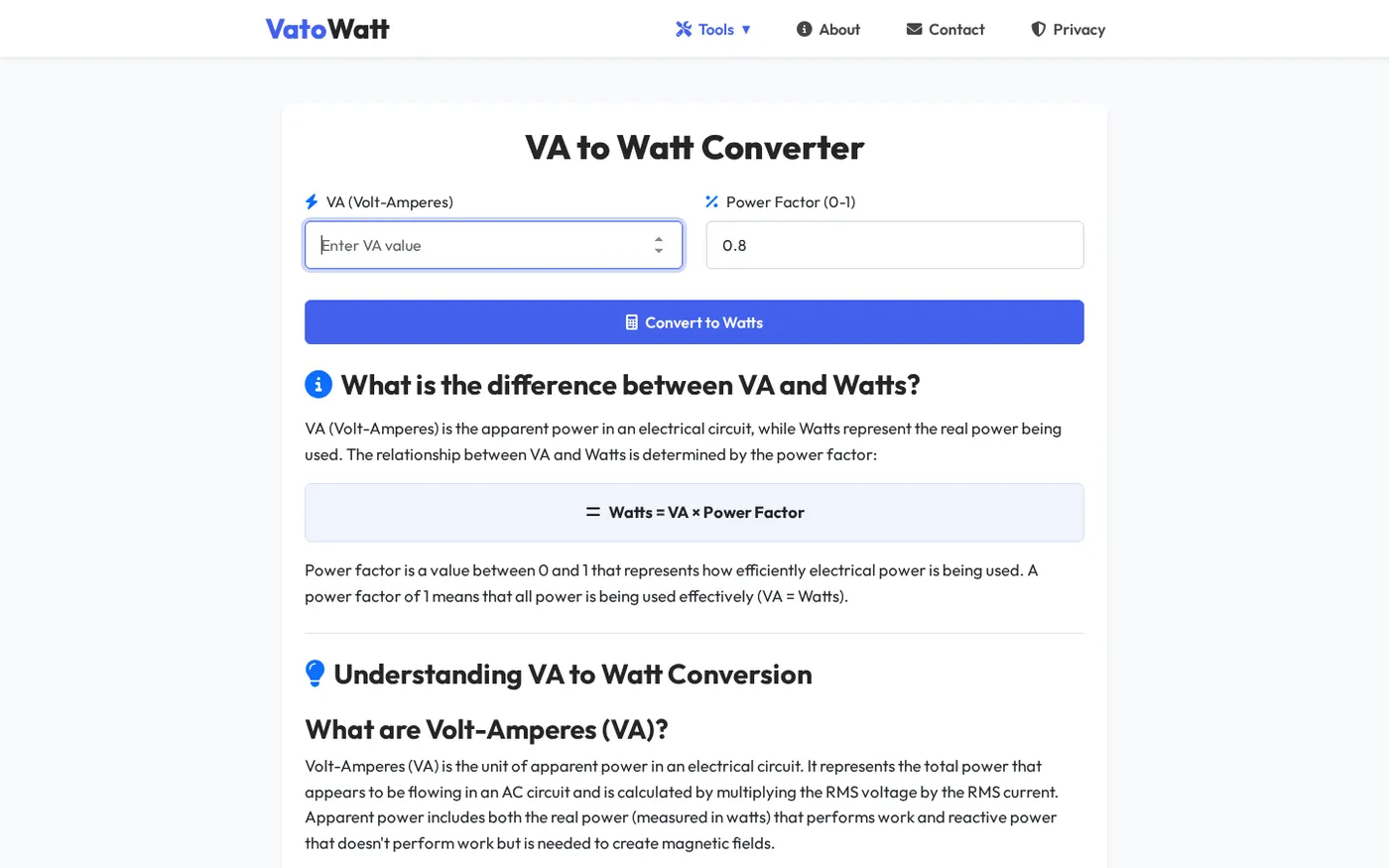
Use the VA to Watt Converter to replace 1,000 and 0.8 with the figures on your inverter label. The calculator keeps the PF visible so you can see why the result changes.
Example 2: 1.5 kVA at PF 0.8
First convert kVA to VA:
1.5 kVA = 1,500 VA
Then apply the formula:
1,500 VA × 0.8 = 1,200 W
So, 1.5 kVA is 1.2 kW at PF 0.8. At PF 1.0, the numerical result would instead be 1.5 kW.
Example 3: 2 kVA at different PF values
The same 2 kVA label can produce different watt estimates depending on PF:
| Power factor | Calculation | Real power from 2 kVA |
|---|---|---|
| 0.7 | 2,000 × 0.7 | 1,400 W |
| 0.8 | 2,000 × 0.8 | 1,600 W |
| 0.9 | 2,000 × 0.9 | 1,800 W |
| 1.0 | 2,000 × 1.0 | 2,000 W |
Do not use a generic PF if the equipment documentation gives a watt limit. The lower of the label’s VA-derived capacity and stated watt capacity is the safer planning boundary.
Converting watts to VA for an inverter or UPS
If you know the appliance load in watts, divide by PF to find the apparent demand:
VA = watts ÷ PF
For example, a 500 W load at PF 0.8 needs:
500 ÷ 0.8 = 625 VA
That is the mathematical minimum apparent capacity for the stated load and PF. In practice, you also need headroom and enough surge capacity for compressors, pumps, coolers or other motors. The Watt to VA Converter is useful when you start with a measured or nameplate watt load.
For a complete home setup, add the running watts of appliances that operate together and check their starting requirements. The Inverter Load Calculator lets you list each appliance, quantity and surge factor instead of treating the whole house as one assumed PF.
VA, watts and battery backup are different checks
VA tells you about the inverter’s electrical capacity. Watts tell you the real load. Neither number alone tells you how many hours the battery will run.
Battery runtime needs battery capacity, battery voltage, usable efficiency and load watts. For example, a 12 V, 150 Ah battery with a 0.8 usable-efficiency assumption has:
150 Ah × 12 V × 0.8 = 1,440 Wh
At a steady 300 W load:
1,440 Wh ÷ 300 W = 4.8 hours
That is about 4 hours 48 minutes as a planning estimate. The Battery Backup Time Formula explains the calculation and why actual runtime can differ. You can then use the Battery Backup Calculator with your own battery and load values.
Common mistakes with VA and watts
- Treating VA and watts as interchangeable: they have the same number only when PF is 1.0.
- Using battery voltage in the VA formula: VA for an AC load uses the AC voltage and current; battery runtime is a separate DC energy calculation.
- Ignoring the manufacturer’s watt limit: a 1,000 VA unit may have a stated limit below 800 W, and that label limit still applies.
- Sizing only for running watts: fridges, pumps and coolers may need extra starting capacity.
- Confusing power with energy: W and VA describe a rate or capacity; Wh and kWh describe energy over time.
- Assuming every appliance has PF 0.8: use the equipment specification when available, and call an estimate an estimate when it is not.
FAQ
Is VA the same as watts?
No. VA is apparent power and watts are real power. They are numerically equal only at a power factor of 1.0; otherwise, use watts = VA × PF.
How many watts is 1,000 VA?
At PF 0.8, 1,000 VA equals 800 W. The actual usable watt limit may be different if the inverter or UPS nameplate states a separate maximum watt rating.
Why are UPS units rated in VA instead of watts?
VA reflects the voltage and current the UPS must handle, even when the connected load’s PF is not known. Watts still matter because they describe the real power consumed by the equipment, so many UPS units show both ratings.
How do I convert watts to VA?
Divide watts by the power factor: VA = watts ÷ PF. A 500 W load at PF 0.8 is 625 VA before allowing for headroom or starting demand.
Does a fridge’s running wattage tell me its inverter size?
Not by itself. A refrigerator’s compressor can draw a higher starting demand, so check both its running information and the inverter’s surge capability and watt/VA limits.