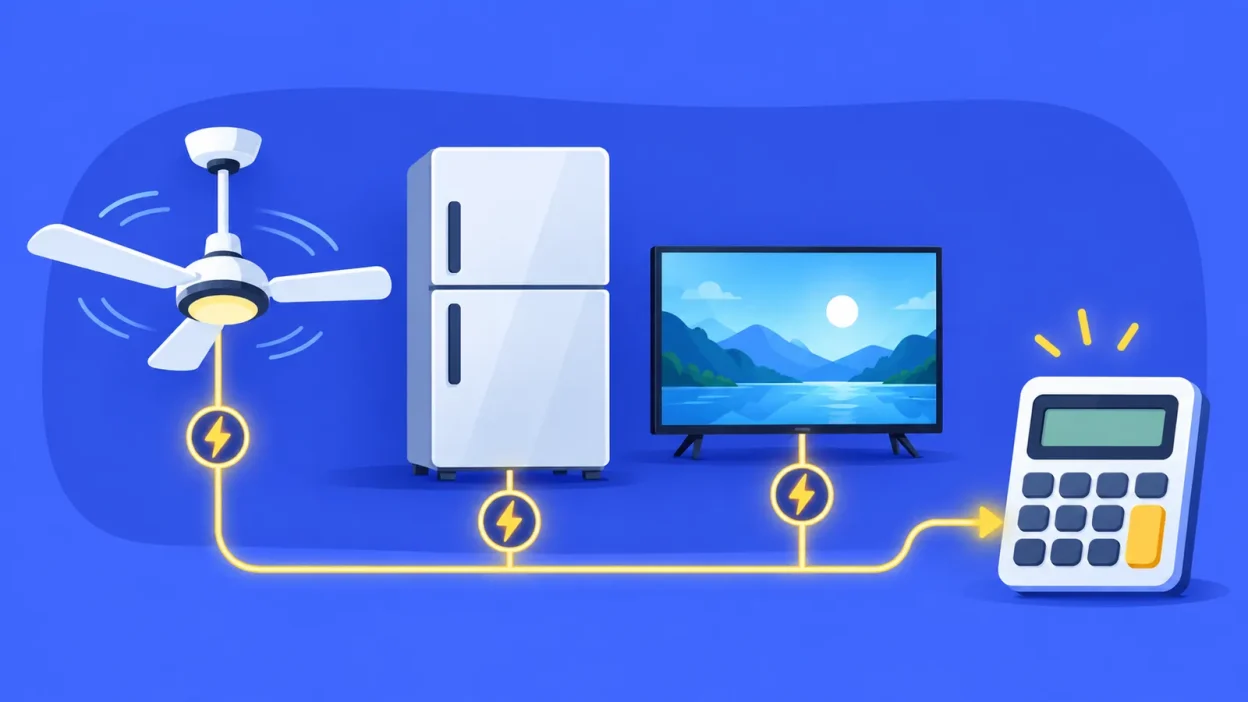
How to calculate power consumption at home comes down to one chain: appliance watts × hours of use → kilowatt-hours (kWh), or electricity units → estimated ₹ cost. This guide works through a fan, fridge, AC and TV, then checks a complete 2BHK example with the numbers you can replace with your own.
What you need before you start
Why this matters: a consumption estimate is only as useful as its wattage and usage inputs.
Collect these details for each appliance:
- The power rating in watts (W), or the annual energy figure if the appliance label gives one instead.
- The number of identical appliances, such as three fans or six bulbs.
- The number of hours each appliance runs on a typical day.
- The number of days in your billing period. Use 30 days for a quick monthly estimate.
- Your electricity tariff in ₹ per unit (₹/kWh), taken from your bill or tariff schedule.
For appliances that cycle, such as a refrigerator or inverter AC, use an estimated effective running time or the appliance’s energy-label figure. Do not assume that a compressor draws its full rated watts for every minute that the appliance is switched on.
The formula in one line
Why this matters: keeping watts, hours and units separate prevents the most common thousand-fold mistake.
For one appliance, use:
Daily energy (kWh) = watts × quantity × hours per day ÷ 1,000
Monthly units = daily energy × number of days
Estimated cost = units × your tariff in ₹/unit
One kilowatt-hour is one unit on an Indian electricity bill. For example, a 1,000 W appliance running for 1 hour uses 1 kWh, while a 100 W appliance running for 10 hours also uses 1 kWh.
If the label already gives energy in kWh per day, month or year, use that figure for the relevant period instead of multiplying rated watts by hours. The watt formula is a planning estimate when the appliance’s actual operating power changes.
Step 1: List appliances and realistic hours
Why this matters: the same appliance can add very different units depending on how long you use it.
Write one row for each appliance or group:
| Appliance | Quantity | Example watts each | Hours per day |
|---|---|---|---|
| Ceiling fan | 3 | 70 W | 10 |
| LED bulb | 6 | 9 W | 5 |
| Refrigerator | 1 | 180 W | 8 effective |
| Television | 1 | 100 W | 4 |
| Wi-Fi router | 1 | 12 W | 24 |
These are worked-example values, not universal ratings. Count only the appliances you actually use, and estimate hours from your routine rather than copying a round number for every device. For a fridge, “8 effective” means an estimate of compressor running time, not eight hours of mains connection.
What success looks like: every appliance has a quantity and a believable daily usage time.
Step 2: Find each appliance’s watts
Why this matters: the watt value is the input to the calculation, and a generic appliance chart can be far from your model’s actual rating.
Check the appliance in this order:
- Read the rating plate, adaptor or user manual for
W,wattsor input power. - For a BEE-labelled appliance, read the energy information on the label. BEE explains that its labels help consumers compare energy performance and cost-saving potential between similar products; see the BEE Standards & Labelling programme.
- If the appliance gives annual or monthly kWh, use that energy figure with the correct period.
- If you have a suitable plug-in power meter, measure normal operation and record the conditions.
Do not use cooling capacity, screen size, battery capacity or a motor’s horsepower as if it were electrical input watts. If the label gives volts and amps rather than watts, ask the manufacturer for input power when possible. A simple volts × amps result may need a power-factor allowance for motors and electronic power supplies.
What success looks like: each row has a wattage from a label, manual, measurement or clearly marked estimate.
Step 3: Calculate daily consumption for each appliance
Why this matters: converting each row to kWh makes appliances with different wattages and run times easy to add.
Multiply watts by quantity and hours, then divide by 1,000:
Daily kWh = watts × quantity × hours ÷ 1,000Worked example: fan, fridge, AC and TV
Use one example appliance of each type. Replace these inputs with your own ratings:
| Appliance | Calculation | Daily energy | 30-day units |
|---|---|---|---|
| Ceiling fan | 70 W × 1 × 10 h ÷ 1,000 | 0.70 kWh | 21 units |
| Refrigerator | 180 W × 1 × 8 h ÷ 1,000 | 1.44 kWh | 43.2 units |
| Inverter AC | 1,500 W × 1 × 4 h ÷ 1,000 | 6.00 kWh | 180 units |
| Television | 100 W × 1 × 4 h ÷ 1,000 | 0.40 kWh | 12 units |
| Total | 8.54 kWh/day | 256.2 units/month |
For the fan, the arithmetic is 70 × 10 ÷ 1,000 = 0.70 kWh per day. For the four appliances together, 0.70 + 1.44 + 6.00 + 0.40 = 8.54 kWh per day, and 8.54 × 30 = 256.2 units in a 30-day month.
This is a useful first estimate, not a promise that the AC draws 1,500 W continuously or that the fridge compressor runs for exactly 8 hours. Use the nameplate, BEE label or a measurement when you need a closer result.
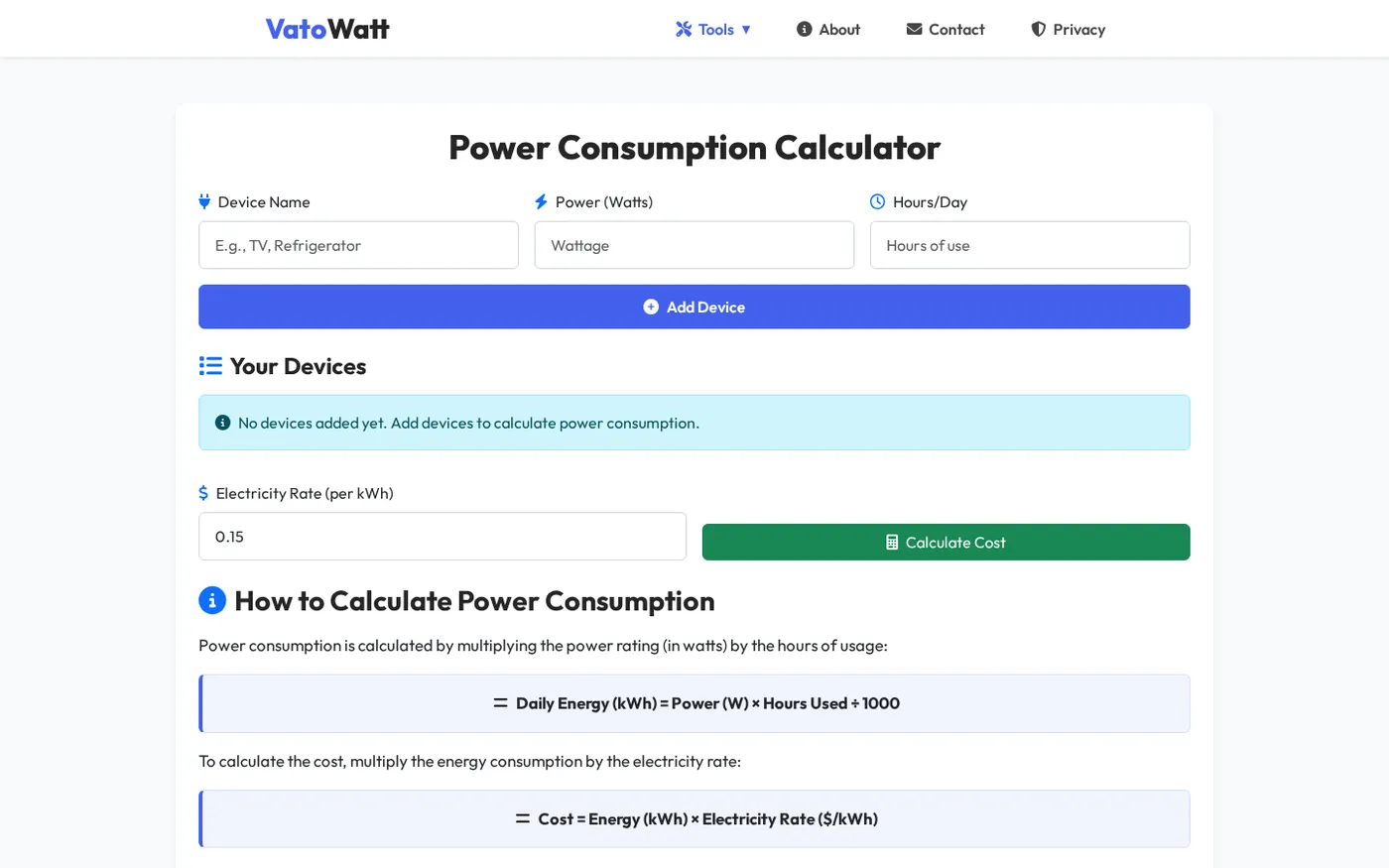
Use the VatoWatt Power Consumption Calculator to enter the same rows and see each appliance’s daily energy and the total units.
What success looks like: every row has daily kWh, and adding the rows gives one daily total.
Step 4: Build a full 2BHK monthly estimate
Why this matters: a bill comes from all appliances over a billing period, not from the largest appliance alone.
Here is a worked 2BHK estimate using 30 days. The AC, geyser, microwave and washing-machine inputs are examples; replace them with your actual model and routine.
| Appliance | Quantity | Example watts each | Hours/day | Daily kWh | 30-day units |
|---|---|---|---|---|---|
| Ceiling fan | 3 | 70 W | 10 | 2.10 | 63.00 |
| LED bulb | 6 | 9 W | 5 | 0.27 | 8.10 |
| Refrigerator | 1 | 180 W | 8 effective | 1.44 | 43.20 |
| Television | 1 | 100 W | 4 | 0.40 | 12.00 |
| Wi-Fi router | 1 | 12 W | 24 | 0.288 | 8.64 |
| Washing machine | 1 | 500 W | 0.5 average | 0.25 | 7.50 |
| Inverter AC | 1 | 1,500 W | 4 | 6.00 | 180.00 |
| Microwave oven | 1 | 1,200 W | 0.25 average | 0.30 | 9.00 |
| Water purifier | 1 | 25 W | 1 | 0.025 | 0.75 |
| Geyser | 1 | 2,000 W | 0.5 | 1.00 | 30.00 |
| Total | 12.073 kWh/day | 362.19 units/month |
For example, the three fans contribute 70 × 3 × 10 ÷ 1,000 = 2.10 kWh/day. The complete table contributes 12.073 × 30 = 362.19 units before any rounding.
Notice how the AC contributes 180 of the 362.19 estimated units. That does not make the table a universal “2BHK consumption” figure: a home without an AC, with a different fan speed or with shorter geyser use will produce a different result.
What success looks like: you have one monthly-unit total and can identify which rows drive most of it.
Step 5: Convert units to rupees
Why this matters: the unit total is comparable across bills, while the ₹ estimate depends on your tariff and billing rules.
Use your own per-unit tariff:
Estimated appliance cost = monthly units × ₹ per unitUsing the four-appliance example above and an assumed rate of ₹8 per unit only to show the maths:
256.2 units × ₹8/unit = ₹2,049.60 estimated energy costThe 2BHK table would be 362.19 × ₹8 = ₹2,897.52 on the same simple assumption. Your actual bill can differ because domestic tariffs may use slabs, fixed charges, taxes, fuel adjustments, subsidies or other line items. Treat this multiplication as an appliance-energy estimate, not a guaranteed final bill.
The calculator may display a default $0.15/kWh rate. That is not an Indian tariff: type your own ₹/unit value before reading the cost result.
What success looks like: the cost calculation uses the rate printed on your bill or the rate you are deliberately testing, not a copied default.
Step 6: Verify the result against your bill
Why this matters: verification catches missing appliances, wrong hours, a misplaced zero or a fridge/AC assumption that is too high.
- Enter each appliance, wattage, quantity and hours in the Power Consumption Calculator.
- Use the same 30-day period as the table, or enter the actual number of days in your billing cycle.
- Enter your own ₹/unit tariff and record the daily kWh, monthly units and estimated cost.
- Compare the monthly units with the consumption or kWh line on your bill.
- If your estimate is much lower, check overlooked loads such as a second fridge, water pump, set-top box, standby devices, lights in other rooms or longer summer AC use.
- If your estimate is much higher, check whether you treated a refrigerator or inverter AC’s rated watts as continuous full-load operation.
Use the bill as a reality check, not as proof that every appliance row is exact. A home meter measures the combined system, while your table uses assumed wattages and hours.
What success looks like: the calculator uses the same assumptions as your table, and the difference from the bill has a reasonable explanation.
Power consumption, power and current are different
Power is the rate at which an appliance uses electricity, measured in watts. Energy consumption is power multiplied by time, measured in watt-hours or kWh. Current is electrical flow in amperes; it can help with circuit planning, but current alone does not tell you how many units an appliance adds to your bill.
For a simple resistive load, watts are approximately volts × amps. For motors, ACs, fridges and electronic power supplies, power factor and changing load can make that shortcut unsuitable. For bill estimation, start with the appliance’s input watts or kWh label, then multiply by realistic hours.
Common mistakes
Dividing by 100 instead of 1,000
Watts become kilowatts by dividing by 1,000. A 100 W appliance running for 10 hours uses 100 × 10 ÷ 1,000 = 1 kWh, not 10 units.
Treating watts as “watts per hour”
Watts describe a rate. The time-based result is watt-hours or kilowatt-hours, so write 100 W for power and 1 kWh for energy used in the example above.
Using the rupee bill amount as energy use
Use the bill’s units or kWh reading. The amount payable can include fixed charges and slab rates, so it cannot be converted back to appliance units with one universal ₹ figure.
Assuming every appliance runs at full rating
An AC compressor cycles, a fridge switches on and off, and a washing machine runs only during its programme. Mark such rows as estimates, use a measured average or use the label’s period-based energy figure.
Forgetting quantity
Three 70 W fans running for 10 hours use 70 × 3 × 10 ÷ 1,000 = 2.1 units/day. Calculating one fan and forgetting the other two understates the total.
Mixing energy consumption with inverter load
Power consumption uses watts over time and produces kWh. Inverter sizing uses the watts running together and may also need motor-starting surge. For that separate question, use the Inverter Load Calculator.
FAQ
What is the formula for calculating power consumption?
For one appliance, use watts × quantity × hours per day ÷ 1,000 to get daily kWh, or units. Multiply daily kWh by the number of days for a monthly estimate, then multiply units by your own ₹/unit tariff for an estimated energy cost.
How many units does a 100 W appliance use?
A 100 W appliance running for 1 hour uses 100 × 1 ÷ 1,000 = 0.1 kWh, or 0.1 unit. If it runs for 10 hours, it uses 1 unit under the assumption that it draws 100 W throughout.
How do I calculate AC power consumption in India?
Find the AC’s electrical input watts or annual energy figure on its label or manual, then multiply the input estimate by the hours it operates and divide by 1,000. Inverter ACs change their input while running, so a nameplate calculation is an estimate; compare it with the BEE label or a suitable energy meter when possible.
How can I calculate fridge power consumption?
Use the refrigerator’s BEE annual energy figure if it is available, or multiply its input-watt estimate by an effective compressor runtime rather than 24 hours. The compressor cycles, so rated watts × all 24 hours usually overstates normal energy use.
Why does my calculated bill differ from my electricity bill?
Your table may omit appliances or use different hours, while a fridge and AC may not draw their rated watts continuously. The bill can also include fixed charges, taxes, slab rates and other adjustments, so compare the units or kWh line first and treat the ₹ result as an estimate.
Related calculators
- VA to Watt Converter — convert an inverter or UPS VA rating to watts.
- Watt to VA Converter — find the estimated VA for a watt load.
- Inverter Load Calculator — total simultaneous appliance watts and account for startup demand.
- Battery Backup Calculator — estimate inverter or UPS runtime from battery Ah, voltage and load.
- Solar Panel Calculator — estimate panels from daily energy use.
- Power Consumption Calculator — calculate appliance kWh, units and estimated cost.