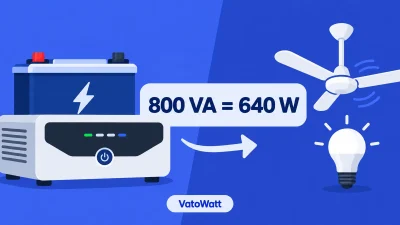
1500va to watts is 1,200 W at a power factor (PF) of 0.8, the planning value used by this calculator. The exact watt capacity depends on the inverter or UPS nameplate and its stated PF, so check both numbers before connecting appliances.
1500 VA to watts: 1,200 W at PF 0.8
Use this formula:
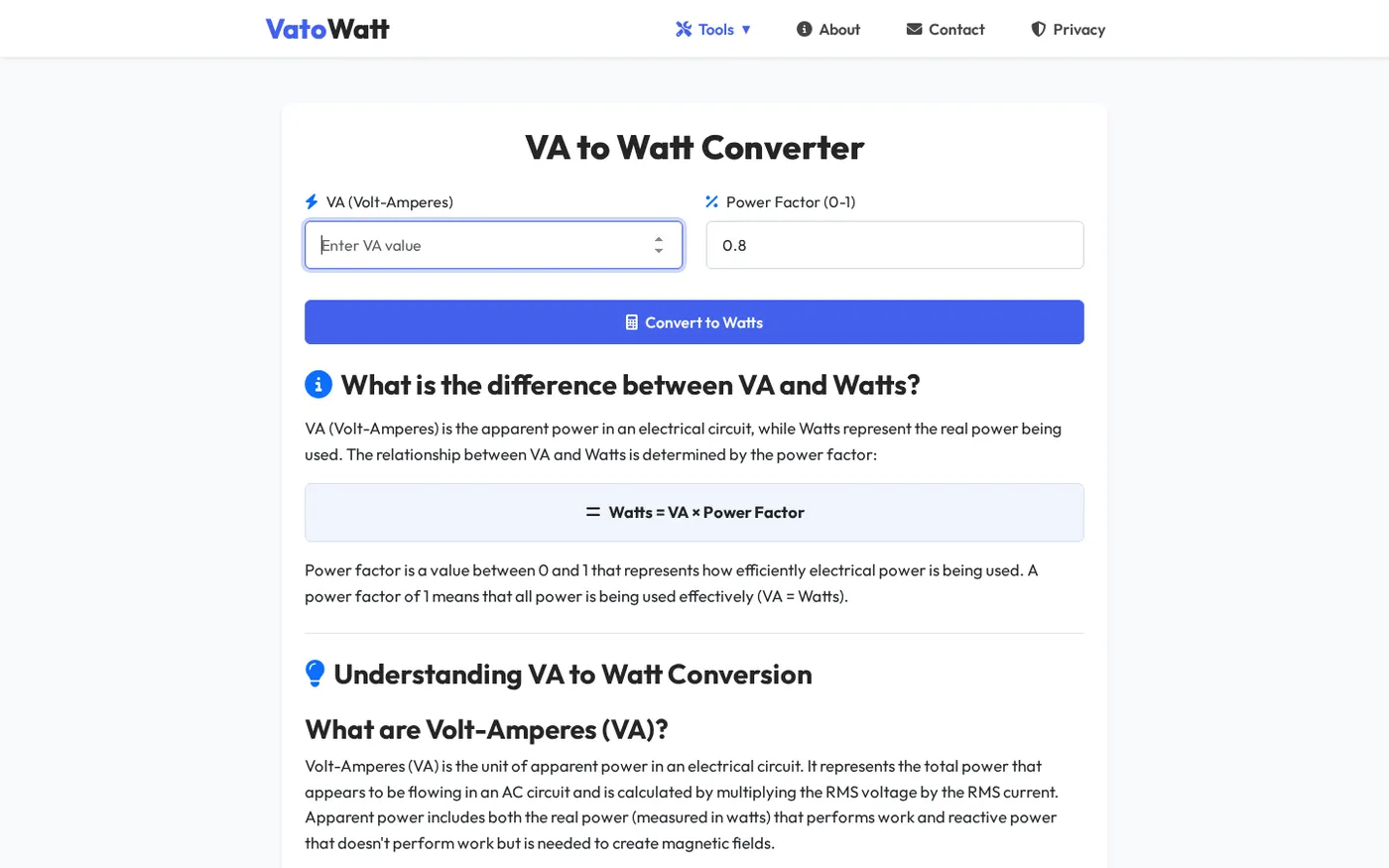
Watts = VA × power factor
      = 1,500 × 0.8
      = 1,200 W
So, a 1500 VA inverter with a 0.8 power factor has a calculated real-power capacity of 1,200 W.
If the label gives another maximum watt figure, use it: the label takes priority over a generic PF assumption. Re-run the calculation with your own PF in the VA to Watt Converter, which starts with PF 0.8.
How the conversion works: W = VA × PF
VA means volt-amperes, or apparent power: the total demand seen by an AC source. Watts measure real power—the part that does useful work, such as running a fan or lighting an LED.
Power factor tells you how much of the apparent power becomes real power:
PF = watts ÷ VA
Watts = VA × PF
VA = watts ÷ PF
For example, PF 0.8 means the real-power figure is 80% of the VA figure:
1,500 VA × 0.8 = 1,200 WAt PF 1.0, VA and watts are numerically equal; reactive demand makes the PF lower. Fluke’s electrical glossary defines VA as apparent power and explains that AC watts include the power factor.
1500 VA at different power factors
The same 1500 VA rating produces different watt figures when the PF changes. Confirm the manufacturer’s watt limit.
| Power factor | Calculation | 1500 VA in watts |
|---|---|---|
| 0.6 | 1,500 × 0.6 | 900 W |
| 0.7 | 1,500 × 0.7 | 1,050 W |
| 0.8 | 1,500 × 0.8 | 1,200 W |
| 0.9 | 1,500 × 0.9 | 1,350 W |
| 1.0 | 1,500 × 1.0 | 1,500 W |
If an inverter is marked 1500 VA / 1200 W, its implied PF is:
1,200 W ÷ 1,500 VA = 0.8 PFIf it is marked 1500 VA / 900 W, plan around 900 W instead. The nameplate takes priority over a generic table.
What can a 1500 VA inverter run? A 3BHK example
A 1500 VA unit at PF 0.8 can support up to 1,200 W of calculated real load. This illustrative 3BHK example uses assumed running watts:
| Appliance | Assumed watts | Quantity | Total watts |
|---|---|---|---|
| Ceiling fan | 70 W | 4 | 280 W |
| LED bulb | 9 W | 8 | 72 W |
| Television | 100 W | 1 | 100 W |
| Wi-Fi router | 12 W | 1 | 12 W |
| Refrigerator while running | 180 W | 1 | 180 W |
| Air cooler | 200 W | 1 | 200 W |
| Total running load | 844 W |
The total is 844 W, which is below the 1,200 W planning figure. If you use PF 0.8 as a rough combined-load estimate, the apparent demand is:
844 W ÷ 0.8 = 1,055 VAThat is below 1,500 VA as a rough check. A refrigerator and air cooler have motors, so starting demand can be higher than running watts; check the inverter’s surge rating and appliance labels.
Enter your own fans, lights, fridge, cooler and electronics in the Inverter Load Calculator to check running load, quantities, surge factors and battery sizing.
1500 VA on 24 V: what battery bank does it need?
The 1500 VA rating alone cannot tell you the battery size. Battery capacity depends on load watts and desired backup time.
For a 24 V bank, use the inverter-load assumptions of 85% inverter efficiency and 50% usable depth of discharge for a simple planning calculation:
Battery Ah = AC load W × backup hours
             ÷ (battery V × inverter efficiency × usable discharge)
For 1,200 W for 1 hour:
Battery Ah = 1,200 × 1 ÷ (24 × 0.85 × 0.50)
           = 117.6 Ah
That is about 118 Ah at 24 V. Compare battery sizes with the maker’s usable-capacity guidance. Two matching 12 V batteries in series make a 24 V bank while keeping the Ah rating the same.
The watt load and desired hours therefore matter more than the inverter’s VA number. Use the Battery Backup Calculator for a quick estimate with your battery voltage, Ah and load.
How to check whether your load fits
Use the lower applicable limit when checking a 1500 VA inverter:
- Add the running watts of the appliances you want to use together.
- Compare the total with the inverter’s stated maximum watts.
- Check apparent-power and surge limits for motors, compressors, pumps and coolers.
- Leave practical headroom instead of planning to run continuously at the exact maximum.
An 844 W running load fits below 1,200 W here, but another 1500 VA model may have a lower watt rating. If you know the load in watts, use the Watt to VA Converter.
Common mistakes with a 1500 VA UPS
- Assuming 1500 VA means 1500 W: at PF 0.8, it is 1,200 W.
- Ignoring the nameplate: use the manufacturer’s watt rating when it differs from your calculation.
- Sizing only for running watts: motor-driven appliances can need extra starting capacity; watt-hours describe energy over time.
FAQ
Is 1500 VA equal to 1500 watts?
Only at a power factor of 1.0. At the common planning value of PF 0.8, 1500 VA converts to 1,200 W.
How many watts can a 1500 VA UPS handle?
At PF 0.8, the calculation gives 1,200 W. The UPS may have a different stated watt capacity, so use the lower applicable nameplate limit and account for surge demand.
Can a 1500 VA inverter run a 3BHK home?
It can support a selected backup load, not automatically every appliance in a 3BHK home. The worked example totals 844 W with four fans, eight LED bulbs, a TV, router, refrigerator and cooler, but you must check your actual wattages and starting demand.
What battery is needed for a 1500 VA inverter?
There is no single battery size based only on 1500 VA. For a 1,200 W load running for 1 hour, the worked estimate is about 118 Ah at 24 V using 85% inverter efficiency and 50% usable discharge; longer backup or a different load needs a different calculation.