Watts to kWh conversion needs two values: the appliance power in watts and the time it runs in hours. Use kWh = (watts × hours) ÷ 1,000; the result is the electricity-unit reading used on your bill.
Watts to kWh formula
Watts (W) show a power rate; kWh shows total energy over time. A watt value needs a running time before it can be expressed in kWh.
Energy (kWh) = Power (W) × Time (hours) ÷ 1,000For example, an 800 W appliance running for 3 hours uses:
(800 × 3) ÷ 1,000 = 2.4 kWhThe U.S. Department of Energy defines a kilowatt-hour as one kilowatt used for one hour. Read its definition of kilowatt and kilowatt-hour. For minutes, divide by 60 first: a 1,500 W geyser used for 20 minutes is about 0.5 kWh.
To estimate cost, use this second formula:
Electricity cost = kWh × your tariff in ₹ per unitEnter your own ₹/unit rate from the bill; the calculator’s displayed dollar example is not an Indian tariff.
1 unit = 1 kWh: what your bill means
One electricity unit is 1 kWh. In smaller units, that is 1,000 watt-hours (Wh). So these are all the same amount of energy:
- 1,000 W for 1 hour = 1 kWh = 1 unit
- 500 W for 2 hours = 1 kWh = 1 unit
The “units consumed” line on your bijli bill is the total kWh used during the billing period. If your meter shows 180 units, the household used 180 kWh; it does not mean one appliance used 180 kW at one moment.
Table: 10 W to 2,000 W over 1, 8 and 24 hours
Use this table for a quick estimate. The 8-hour and 24-hour columns assume continuous use at the listed wattage.
| Appliance power | 1 hour | 8 hours | 24 hours |
|---|---|---|---|
| 10 W | 0.01 kWh | 0.08 kWh | 0.24 kWh |
| 40 W | 0.04 kWh | 0.32 kWh | 0.96 kWh |
| 60 W | 0.06 kWh | 0.48 kWh | 1.44 kWh |
| 100 W | 0.10 kWh | 0.80 kWh | 2.40 kWh |
| 200 W | 0.20 kWh | 1.60 kWh | 4.80 kWh |
| 500 W | 0.50 kWh | 4.00 kWh | 12.00 kWh |
| 1,000 W | 1.00 kWh | 8.00 kWh | 24.00 kWh |
| 1,500 W | 1.50 kWh | 12.00 kWh | 36.00 kWh |
| 2,000 W | 2.00 kWh | 16.00 kWh | 48.00 kWh |
Multiply power by time and divide by 1,000, then check your appliance label because actual loads vary.
Worked examples for a geyser, AC and fan
2,000 W geyser for 30 minutes
Suppose a heating element is rated at 2,000 W and runs for 30 minutes each day.
30 minutes ÷ 60 = 0.5 hours
(2,000 × 0.5) ÷ 1,000 = 1 kWh per day
For a 30-day month, the estimate is 1 × 30 = 30 kWh, or 30 units. If a thermostat switches the element off, use the average running time for a closer estimate.
1,500 W AC for 6 hours
If an AC draws 1,500 W while operating, then:
(1,500 × 6) ÷ 1,000 = 9 kWh per day
9 × 30 = 270 kWh per 30-day month
An AC may cycle rather than draw its rated power continuously, so treat 9 kWh as a full-load estimate rather than a guaranteed bill reading.
70 W fan for 8 hours
For a fan labelled 70 W and used for 8 hours:
(70 × 8) ÷ 1,000 = 0.56 kWh per day
0.56 × 30 = 16.8 kWh per 30-day month
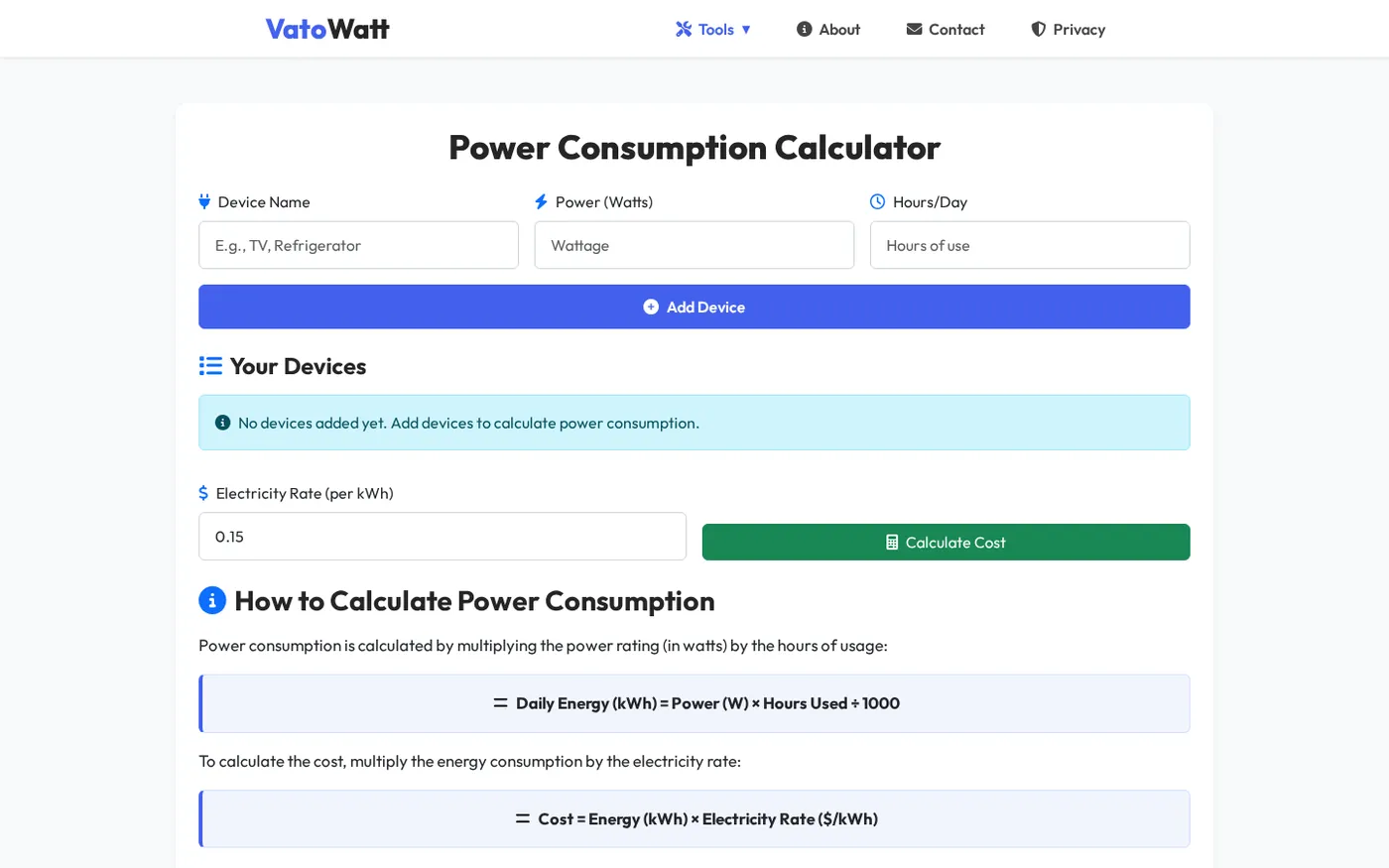
Repeat the calculation for each appliance and add the daily or monthly kWh values. For a faster multi-appliance calculation, use the VatoWatt Power Consumption Calculator, which accepts wattage, quantity, hours and your own tariff.
How to calculate daily, monthly and bill cost
Follow these steps:
- Find the power rating. Read the label, nameplate or adapter. If it shows kilowatts, multiply by 1,000; 1.2 kW is 1,200 W.
- Estimate the running time. Record hours per day and divide minutes by 60.
- Calculate daily energy. Use
watts × hours per day ÷ 1,000. - Calculate monthly energy. Multiply daily kWh by the number of days in your billing period. Use 30 only as a simple estimate when the exact period is not known.
- Estimate cost. Multiply kWh by your bill’s ₹/unit tariff. Slabs and fixed charges mean this will not reproduce the final bill exactly.
For example, three 10 W LED bulbs used for 5 hours per day consume (10 × 3 × 5) ÷ 1,000 = 0.15 kWh per day. Over 30 days, that is 4.5 units. Quantity belongs in the formula because three identical appliances use three times the energy of one.
If you are using kWh to plan backup rather than estimate your bill, keep the questions separate: kWh is energy over time, while inverter sizing also needs the simultaneous watt load. For the next step, see the battery backup time formula and use the Inverter Load Calculator for a list of appliances.
Common watts-to-kWh mistakes
- Stopping at kW: 1,500 W is 1.5 kW, not 1.5 kWh. It becomes 1.5 kWh after one hour.
- Forgetting time: 100 W is 0.1 kWh after 1 hour, 0.8 kWh after 8 hours and 2.4 kWh after 24 hours.
- Using minutes as hours: 30 minutes is 0.5 hours, not 30 hours or 0.30 hours.
- Assuming the label is the average draw: motors, fridges and inverter ACs can cycle. Use realistic running hours or measured consumption.
- Mixing units or tariffs: watts are power, watt-hours are energy, and kWh is watt-hours divided by 1,000. Enter your own ₹/unit value, not a foreign calculator’s dollar rate.
FAQ
Can you convert watts to kWh without hours?
No. Watts measure the rate of power use, while kWh measures accumulated energy. You need the time period, then use kWh = watts × hours ÷ 1,000.
How many kWh is 1 unit of electricity?
1 unit is exactly 1 kWh. It is the energy used by a 1,000 W appliance running for 1 hour, or by a 100 W appliance running for 10 hours.
How many kWh does a 1,000 W appliance use in one hour?
It uses 1 kWh, which is 1 unit, if it draws 1,000 W continuously for the full hour. If it cycles or runs for less time, its actual use will be different.
How do I calculate monthly units from watts?
Multiply watts by hours used per day and days in the billing period, then divide by 1,000. For multiple appliances, calculate each one separately and add the kWh results.
How do I calculate electricity cost from kWh?
Multiply the energy used in kWh by your electricity tariff in ₹ per unit. Slab rates, fixed charges and taxes can make the final bill different from this simple appliance estimate.