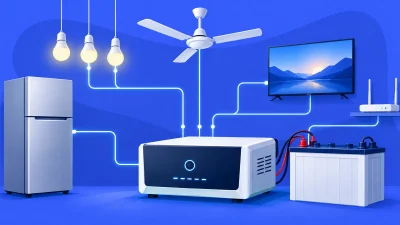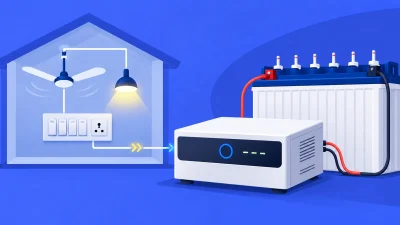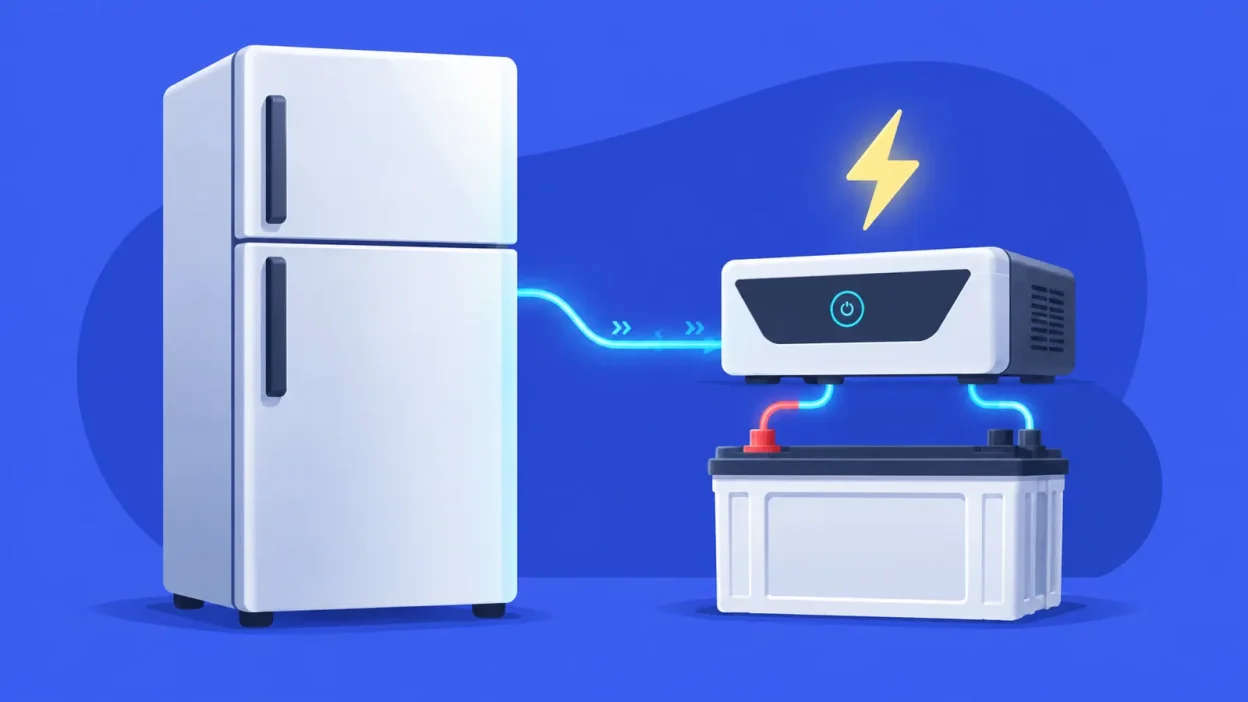
An inverter for fridge use can keep your refrigerator running during a power cut, but it must handle the compressor’s starting surge as well as its normal running load. This guide shows you how to read the fridge watts, apply a 3x planning surge factor, convert the result to VA, estimate battery backup and check waveform compatibility.
Quick answer: yes, if the inverter handles the start surge
Yes, a refrigerator can run on a home inverter when the inverter has enough continuous output, surge capacity, a compatible waveform and a battery sized for the outage. The important number is not only the wattage printed on the refrigerator: a compressor can briefly demand more power when it starts.
For a safe first calculation, use the fridge’s actual running watts and a 3x surge factor when the manufacturer does not give a starting-current figure. Then check the inverter’s continuous watts and peak or surge rating separately. A VA number by itself does not prove that the inverter will start the compressor.
Do not use the annual kWh number on a BEE label as the fridge’s starting wattage. The Bureau of Energy Efficiency describes its star-label programme as information about appliance energy performance and consumption; it is useful for comparing energy use, not for replacing the compressor’s nameplate or manual. BEE’s Standards & Labelling programme explains this purpose.
What you need before sizing
Collect these details before choosing a model:
- Fridge running watts: check the rating plate, manual or manufacturer specification. If the label gives amps instead, record the voltage and current and ask an electrician or manufacturer for the applicable power figure.
- Fridge type: note whether it is a small single-door, double-door frost-free or another format. Size, compressor type and control electronics vary by model.
- Starting demand: use the manufacturer’s inrush or starting-current value if it is available. Otherwise, use 3x as a planning entry and treat it as an estimate.
- Other backup appliances: list fans, LED bulbs, a Wi-Fi router, television or other loads that may run at the same time.
- Backup target: decide whether you need two, four or more hours. The inverter size answers “how much at once”; the battery size answers “for how long”.
- Inverter specifications: check continuous output watts, VA, surge watts and surge duration, waveform, battery voltage and supported battery arrangement.
The refrigerator’s energy label can still help with electricity-use comparisons. For example, an LG 185 L single-door model lists 131 kWh/year and a BLDC smart inverter compressor in its published specifications. That annual figure is not a substitute for the model’s instantaneous running or starting demand, so use the exact appliance documentation when you have it. See the manufacturer’s specification.
Step 1: Separate running watts from starting watts
Why this matters: the compressor may draw a short burst when it starts, and that burst can trip an inverter even when the steady running watts look small.
Do this:
- Write down the fridge’s running load. For this worked example, use 180 W.
- Select a surge factor. Use the documented factor when available; for an initial estimate here, use 3x.
- Multiply the two values:
Starting watts = running watts × surge factor
               = 180 W × 3
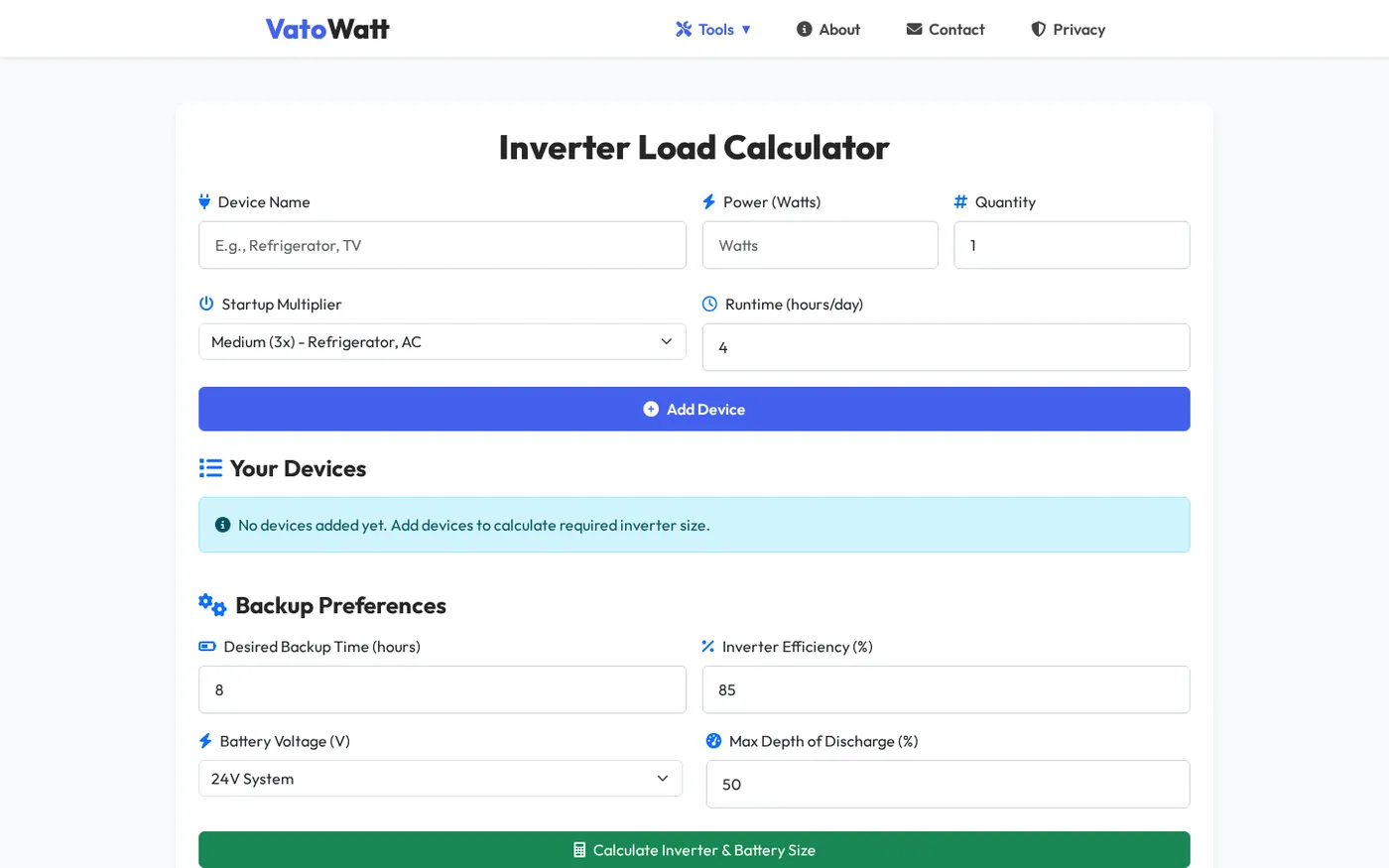
= 540 W- Enter the fridge in the Inverter Load Calculator, set its surge factor to 3x and add any other appliance that may run during the cut.
Success looks like this: you have two separate figures—180 W for the example’s running load and 540 W for its estimated start demand. Do not add the start figure to the running figure for the same fridge; use the larger starting event when checking the inverter’s peak capability.
The 3x value is a planning assumption, not a universal specification. An inverter-compressor fridge may start differently from a conventional compressor, and the actual demand can change with model, temperature and operating condition. If the manual gives a maximum current or surge value, use that value instead.
Step 2: Convert the starting load to a minimum VA
Why this matters: inverters are often labelled in VA, while your appliance list is in watts. Power factor connects the two.
Use these formulas for a first pass:
Watts = VA × power factor
VA = watts ÷ power factor
VatoWatt uses 0.8 as the pre-filled power factor for its planning calculation. For the 180 W fridge example:
Fridge-only minimum VA = 540 W ÷ 0.8
                       = 675 VA
That 675 VA result is the paper calculation for the illustrative fridge’s estimated starting event. It is not a universal buying recommendation. Compare it with an inverter’s actual surge-watt specification, then leave room for any other appliance that can start at the same time.
Here are two worked planning examples. The wattages are examples to replace with your own model’s data, not guaranteed values for every refrigerator.
| Fridge example | Running input | 3x start estimate | Fridge-only VA at 0.8 PF |
|---|---|---|---|
| Small single-door example | 120 W | 360 W | 450 VA |
| Double-door example | 180 W | 540 W | 675 VA |
Success looks like this: your candidate inverter has continuous output above the appliances’ running watts and a surge rating above the starting event for the compressor. If the specification lists only VA and does not state output watts or surge duration, ask for the complete datasheet before treating it as a match.
Step 3: Size the inverter for the fridge plus other appliances
Why this matters: a fridge is rarely the only load on a home inverter. Fans and lights may already use more continuous power than the refrigerator.
Use this 2BHK-style example:
| Appliance | Running watts | Quantity | Running total |
|---|---|---|---|
| Refrigerator | 180 W | 1 | 180 W |
| Ceiling fan | 70 W | 3 | 210 W |
| LED bulb | 9 W | 3 | 27 W |
| Wi-Fi router | 12 W | 1 | 12 W |
| Total running load | 429 W |
The non-fridge appliances total 249 W. When the fridge starts, the planning peak is:
Estimated peak = fridge start estimate + other running load
               = 540 W + 249 W
               = 789 W

VA estimate = 789 W ÷ 0.8
            = 986.25 VA
This example points to an inverter VA rating above about 986 VA, but do not stop at rounding the number to a label. The inverter should also state at least 429 W of continuous output for the running load and enough peak output for the compressor start. If a fan or another motor can start at the same moment, include its starting demand too.
Use the calculator to run two scenarios:
- Enter the refrigerator alone to understand its own requirement.
- Add the fans, lights and router to see the home system requirement.
Success looks like this: you can identify which appliance is driving the peak and which appliances determine the continuous load. This prevents you from sizing only for the fridge and then overloading the inverter with the rest of the backup list.
Step 4: Estimate battery backup time
Why this matters: the inverter can run the load only while the battery supplies enough usable energy. A larger VA rating does not automatically give longer backup.
For a quick runtime estimate, use the VatoWatt Battery Backup Calculator formula:
Backup time (hours) = Ah × battery volts × 0.8 ÷ load wattsWith one 12 V, 150 Ah battery and the example fridge’s 180 W running load:
Backup time = 150 Ah × 12 V × 0.8 ÷ 180 W
            = 8.0 hours
If the same battery is supplying the full 429 W running list:
Backup time = 150 × 12 × 0.8 ÷ 429
            = 3.36 hours
These are steady-load estimates. A refrigerator cycles its compressor, so it does not necessarily draw its running wattage continuously for every minute. At the same time, the inverter has its own consumption, the battery may not deliver its nameplate capacity at every discharge rate, and battery condition affects the result. Read the battery backup time formula and table for the assumptions behind the calculation.
For a target backup period, the Inverter Load Calculator uses 85% inverter efficiency and 50% depth of discharge when it estimates battery Ah. For the fridge alone at 180 W for four hours on a 12 V system:
Required Ah = 180 W × 4 h ÷ (12 V × 0.85 × 0.5)
            = 141.18 Ah
For the full 429 W example:
Required Ah = 429 W × 4 h ÷ (12 V × 0.85 × 0.5)
            = 168.24 Ah
The two examples use different calculator assumptions, so do not mix their outputs as though they were one guarantee. Use the result to compare scenarios, then match the battery voltage, chemistry, charging settings and Ah rating to the inverter documentation.
Success looks like this: you know both the simultaneous load and the target hours, and you have checked the battery estimate against the inverter’s supported voltage and battery requirements.
Step 5: Choose a pure sine wave inverter
Why this matters: a refrigerator combines a compressor motor with control electronics, so the waveform and starting behaviour matter as well as the watt calculation.
Pure sine wave is the safer default for a refrigerator, particularly when the same backup also feeds fans, a television, router or computer. Manufacturer guidance for off-grid AC loads notes that motor-driven equipment can need high start-up current and lists fridges and freezers among typical AC devices. Victron’s AC-device guidance is a useful technical reference.
Check these points in the actual inverter and refrigerator documentation:
- The output is pure sine wave while the battery is supplying the load.
- The continuous watt rating covers the total running load.
- The surge or peak rating covers the compressor start and states how long it can provide that peak.
- The battery voltage is supported by the inverter.
- Any required transfer or UPS mode is compatible with the refrigerator’s controls.
Pure sine wave does not make an undersized inverter large enough. It improves compatibility, but you still need the continuous and surge capacity calculated in the earlier steps.
Success looks like this: the waveform is suitable, the continuous output clears the running load, and the documented surge rating clears the starting requirement.
Step 6: Verify the complete selection
Why this matters: the final inverter choice must satisfy the appliance, battery and backup-time calculations together.
Before purchase or installation, verify the following:
- Read the fridge’s exact running and starting information from its label, manual or manufacturer.
- Replace the illustrative 120 W or 180 W value with your own measured or documented value.
- Set the calculator’s surge factor to the documented figure, or use 3x only as an initial estimate.
- Add every appliance that may run at the same time during a power cut.
- Compare the total running watts with the inverter’s continuous output watts.
- Compare the largest starting event with the inverter’s surge watts and surge duration.
- Check the 12 V, 24 V or 48 V battery-bank requirement and the battery Ah estimate.
- Have a licensed electrician handle installation, terminals, battery-bank changes and wiring. Do not experiment with live mains or high-current battery connections.
Success looks like a complete match across four fields: running watts, starting watts, waveform and battery capacity. If one field is missing from the product specification, the calculation is incomplete.
Common problems when a fridge is on an inverter
The inverter trips when the compressor starts. Recheck the start factor, peak watts and surge duration. Then remove other motor loads from the backup list and compare the fridge’s actual starting-current specification with the inverter’s rating.
The fridge runs, but the battery empties quickly. Check the total running load, inverter idle consumption, battery voltage and battery condition. A 150 Ah battery running 429 W has a much shorter calculated runtime than the same battery running the fridge alone.
The VA calculation looks correct, but the inverter still struggles. Check continuous output watts, not only VA. Also check whether another appliance starts at the same time and whether the inverter’s stated peak is available for long enough.
You only have the BEE annual kWh figure. Use it to compare energy efficiency, but find the model’s electrical rating or manual for running and starting demand. Annual energy consumption cannot tell you the compressor’s instantaneous surge.
You are deciding between a fixed-speed and inverter-compressor fridge. Do not assume a generic surge number applies to both. Use the actual model’s documentation and retain a margin in the inverter’s continuous and peak ratings.
FAQ
Can a 600 VA inverter run a fridge?
It depends on the refrigerator’s actual running watts, starting demand and the inverter’s continuous and surge ratings. For the illustrative 120 W fridge with a 3x start estimate, the fridge-only calculation is 450 VA, but other appliances and the inverter’s peak specification can make 600 VA unsuitable.
What size inverter is needed for a double-door refrigerator?
Start with the model’s running watts and starting-current information, not its door count alone. Using an illustrative 180 W load with a 3x factor gives 540 W peak, or 675 VA at 0.8 power factor before adding fans, lights or other appliances.
How many Ah battery do I need for a fridge?
It depends on the fridge load, battery voltage, efficiency, usable depth of discharge and target hours. In the worked example, 180 W for four hours on a 12 V system gives about 141 Ah using 85% efficiency and 50% depth of discharge; use your own figures in the calculator.
Is a pure sine wave inverter necessary for a refrigerator?
Pure sine wave is the safer default for a refrigerator because it has a compressor motor and electronic controls. It still must have enough continuous and surge capacity, and you should check the inverter and appliance manuals for compatibility.
Can I run a fridge and fan on the same inverter?
Yes, if the inverter’s continuous output covers both running loads and its surge capacity covers the fridge compressor start plus any simultaneous motor start. Add the loads in the Inverter Load Calculator rather than checking the fridge alone.
Related calculators
- VA to Watt Converter — convert an inverter VA rating to watts.
- Watt to VA Converter — convert a known watt load into VA.
- Inverter Load Calculator — size inverter VA and battery Ah from appliances.
- Battery Backup Calculator — estimate runtime from battery Ah, voltage and load.
- Solar Panel Calculator — estimate solar panels from daily electricity use.
- Power Consumption Calculator — estimate appliance units and electricity cost.