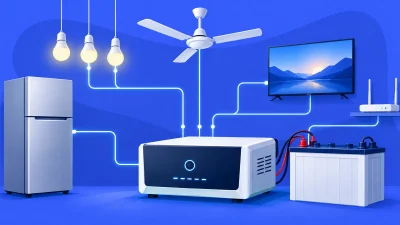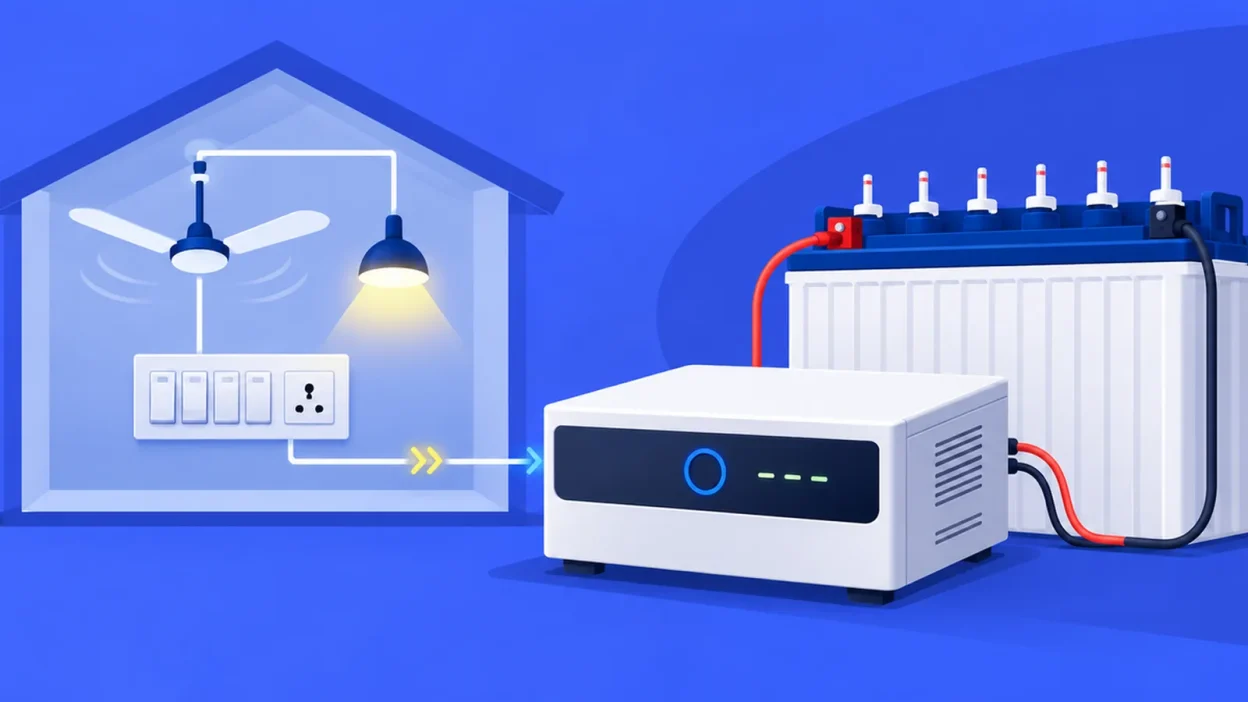
An inverter size chart helps you match the appliances you want during a power cut with the inverter VA rating, battery capacity and expected backup time. This Indian home guide shows the maths for 1BHK, 2BHK, 3BHK and small-shop loads, so you can check the result against your own appliance nameplates.
Quick inverter size chart: load to VA and battery
The table below uses a practical planning basis: 25% headroom above the calculated VA, a power factor of 0.8, 85% inverter efficiency, 50% maximum depth of discharge and roughly 4 hours of backup. The loads are essential backup loads, not every appliance in the home.
| Use case | Running load used | Minimum maths | Practical inverter size | Battery bank for about 4 hours | Approx. backup with that bank |
|---|---|---|---|---|---|
| 1BHK essentials | 300 W | 469 VA | 500 VA | About 235 Ah at 12 V; use a bank totalling about 250 Ah | 4.25 hours |
| 2BHK essentials | 600 W | 938 VA | 1,000 VA | About 235 Ah at 24 V; 2 × 250 Ah, 12 V batteries in series | 4.25 hours |
| 3BHK essentials | 900 W | 1,406 VA | 1,500 VA | About 177 Ah at 48 V; 4 × 200 Ah, 12 V batteries in series | 4.53 hours |
| Small shop or clinic | 500 W | 781 VA | 800 VA | About 196 Ah at 24 V; 2 × 200 Ah, 12 V batteries in series | 4.08 hours |
These are starting points, not a substitute for your actual load list. A refrigerator, water pump, cooler, printer or air conditioner can have a higher starting demand than its running watts. If one of those starts while other appliances are already running, check the inverter’s peak or surge rating as well as its continuous rating.
The battery figures are bank capacity. Two 250 Ah batteries in series make a 24 V, 250 Ah bank, not a 24 V, 500 Ah bank. Series connection raises voltage; it does not add the amp-hour rating. A licensed electrician should confirm the final installation and battery arrangement.
How this inverter size chart was worked out
1. Add only the appliances that run together
Start with the items you genuinely want during an outage. For example, a small backup list might include fans, LED bulbs, a Wi-Fi router, television and selected work equipment. Do not add every appliance in your house unless you intend to run all of them at the same time.
Use the wattage printed on each appliance or in its manual. Ratings vary by model, so the numbers below are illustrations. The Bureau of Energy Efficiency is a useful official reference for broader energy-efficiency information, but your appliance’s own nameplate is the input for this calculation.
2. Convert watts to VA, then add headroom
Watts describe real power. VA describes the apparent power the inverter must handle. For this chart, the calculator’s power-factor assumption is 0.8:
VA = running watts ÷ power factor
Recommended VA = VA × 1.25 headroom
For a 600 W load:
600 W ÷ 0.8 = 750 VA
750 VA × 1.25 = 937.5 VA
The result rounds up to a practical 1,000 VA inverter. If you already know the load in watts and want to check only the conversion, use the Watt to VA Converter.
The 25% headroom is a planning allowance for normal variation and modest expansion. It does not replace a surge check. Motors such as refrigerators, pumps and coolers may need a higher short-duration peak rating when they start.
3. Size the battery for the backup time you need
Battery capacity depends on load, hours, battery-bank voltage, inverter efficiency and the fraction of the battery you plan to use. Using the chart assumptions:
Battery Ah = load W × backup hours
             ÷ (battery voltage × 0.85 × 0.50)
For the 600 W, 24 V, 4-hour example:
600 × 4 ÷ (24 × 0.85 × 0.50)
= 2,400 ÷ 10.2
= 235.3 Ah
That is why the chart shows about 235 Ah at 24 V. A bank totalling 250 Ah gives an estimate of:
24 × 250 × 0.85 × 0.50 ÷ 600 = 4.25 hoursActual backup changes with the load during the outage, battery age and condition, temperature, discharge rate and the inverter’s own idle consumption. Treat the number as an estimate and leave a sensible margin.
1BHK: typical load and inverter size
A basic 1BHK backup list might contain two 75 W fans, four 9 W LED bulbs, one 100 W television and a 15 W router:
2 × 75 W fans   = 150 W
4 × 9 W bulbs   =  36 W
TV              = 100 W
Router          =  15 W
Total           = 301 W
For easy planning, round this to 300 W. The inverter calculation is:
300 ÷ 0.8 × 1.25 = 468.75 VASo the chart rounds up to 500 VA. For about 4 hours at 12 V, the battery calculation is:
300 × 4 ÷ (12 × 0.85 × 0.50) = 235.3 AhA 12 V bank totalling about 250 Ah would provide:
12 × 250 × 0.85 × 0.50 ÷ 300 = 4.25 hoursIf your 1BHK also includes a refrigerator, cooler, desktop computer or printer, add its running watts and check the starting demand. You may need a larger continuous and surge rating than this essentials-only example.
2BHK: typical load and inverter size
A 2BHK often needs more fans and lights, plus a refrigerator and one work device. One illustrative list is three 75 W fans, six 9 W LED bulbs, a 100 W TV, a 15 W router, a 150 W refrigerator running load and a 60 W laptop:
3 × 75 W fans       = 225 W
6 × 9 W bulbs       =  54 W
TV                  = 100 W
Router              =  15 W
Refrigerator load   = 150 W
Laptop              =  60 W
Total               = 604 W
Round the planning load to 600 W. The recommended VA calculation becomes:
600 ÷ 0.8 × 1.25 = 937.5 VAThat points to a 1,000 VA inverter on this simplified basis. For 4 hours, the 24 V battery requirement is about 235 Ah. A 24 V bank made from two 250 Ah, 12 V batteries in series gives roughly 4.25 hours at a steady 600 W load.
The refrigerator’s 150 W figure is only the running-load example. Its compressor can draw more when starting, and it may not run continuously. Enter the model’s running and starting information in the Inverter Load Calculator rather than relying on this rounded row.
3BHK and bigger homes: when to use 24 V or 48 V
A bigger backup list can reach 900 W even before you add a geyser, microwave or air conditioner. One example is four fans at 75 W, eight LED bulbs at 9 W, a TV, router, refrigerator, two laptops, a set-top box and a cooler:
4 × 75 W fans       = 300 W
8 × 9 W bulbs       =  72 W
TV                  = 100 W
Router              =  15 W
Refrigerator load   = 150 W
2 × 60 W laptops    = 120 W
Set-top box         =  20 W
Cooler              = 120 W
Total               = 897 W
Use 900 W as the rounded planning load. The VA result is:
900 ÷ 0.8 × 1.25 = 1,406.25 VAThis gives a practical 1,500 VA planning size. For 4 hours at 48 V:
900 × 4 ÷ (48 × 0.85 × 0.50) = 176.5 AhA 48 V bank totalling about 200 Ah gives an estimate of:
48 × 200 × 0.85 × 0.50 ÷ 900 = 4.53 hoursHigher battery-bank voltage reduces the current needed for the same output power. At 900 W, the approximate battery-side current before other losses is about 22 A at 48 V, compared with about 44 A at 24 V. The correct system voltage must still match the inverter and battery specifications; do not improvise a series or parallel arrangement.
For loads with an air conditioner, pump, microwave or several motor appliances, use their nameplate data and the inverter manufacturer’s surge specification. A larger VA number alone does not guarantee that every appliance will start together.
Small shop or clinic: what changes
For a shop or clinic, the important question is usually which equipment must stay on. A 500 W planning example could include two fans, LED lighting, a router, a desktop computer, a small printer and CCTV equipment:
2 × 75 W fans       = 150 W
6 × 9 W bulbs       =  54 W
Router              =  15 W
Desktop             = 120 W
Printer             = 100 W
CCTV equipment      =  25 W
Other small load    =  36 W
Total               = 500 W
The inverter calculation is:
500 ÷ 0.8 × 1.25 = 781.25 VAThat rounds to an 800 VA planning size. A 24 V bank totalling 200 Ah provides:
24 × 200 × 0.85 × 0.50 ÷ 500 = 4.08 hoursPrinters, photocopiers, compressors and pumps may have brief surges. If those devices are not essential during a cut, leave them off the backup list; this can reduce both the inverter size and battery requirement.
Single or double battery: how to choose
The inverter’s battery voltage tells you how to arrange the bank. A 12 V inverter normally uses one 12 V battery; a 24 V system uses two matching 12 V batteries in series; a 48 V system uses four matching 12 V batteries in series. The battery Ah value stays the same in a series string.
For example, two 250 Ah batteries in series are a 24 V, 250 Ah bank. Their nominal energy is 24 × 250 = 6,000 Wh, but the chart does not treat all of that as usable: 50% depth of discharge and 85% inverter efficiency are applied before estimating AC backup.
Choose the bank from the required hours, not from the inverter’s VA number alone. A 1,000 VA inverter might power a 200 W load for much longer than a 600 W load, but both still need to meet the inverter’s continuous and surge limits. For a more precise result, use the Battery Backup Calculator after you have settled on the real load and bank voltage.
How to select an inverter for your home
Use this short process when the chart row is only a rough match:
- Read the wattage of every appliance you want on backup.
- Add the appliances that can run at the same time.
- Identify motor loads and note their starting or surge requirement.
- Convert the running-watt total to VA using the 0.8 power-factor assumption.
- Add headroom, then round up to the next suitable inverter rating.
- Select 12 V, 24 V or 48 V only after checking the inverter’s supported battery voltage.
- Calculate battery Ah from the outage hours, 85% efficiency and 50% depth-of-discharge assumptions.
- Recheck the final list in the Inverter Load Calculator.
The best size is the one that handles your simultaneous running load, starts the required motor appliances and stores enough energy for your target outage. If your own list is much smaller than a whole-home load, a chart row based on 1BHK, 2BHK or 3BHK may overstate what you need.
FAQ
What inverter size is best for a 2BHK home?
For the illustrative 600 W essential load in this chart, the calculation gives 938 VA after 25% headroom, so a 1,000 VA planning size is appropriate. Your result can be lower or higher depending on the appliances running together and their starting demand.
How many batteries are needed for a 1,000 VA inverter?
VA alone cannot determine the battery count. You need the load in watts, desired backup time, battery-bank voltage, inverter efficiency and allowed depth of discharge. For the chart’s 600 W, 4-hour example, the calculation is about 235 Ah at 24 V, illustrated as two 250 Ah, 12 V batteries in series.
Is a 150 Ah battery enough for a home inverter?
It depends on the load and hours. At 12 V, 85% inverter efficiency and 50% depth of discharge, one 150 Ah battery gives about 2.55 hours at a steady 300 W load; a higher load will reduce that time.
Should I choose a 12 V or 24 V inverter?
Use the voltage supported by the inverter and battery bank. A 24 V or 48 V bank can carry the same power with less current than a 12 V bank, which is useful as the load grows, but the batteries must be matched and installed correctly.
Does a higher VA inverter give more backup time?
No. VA is the inverter’s power-handling capacity; backup time mainly depends on the battery energy available and the load you run. A larger inverter can handle more load, but that larger load can also drain the same battery faster.