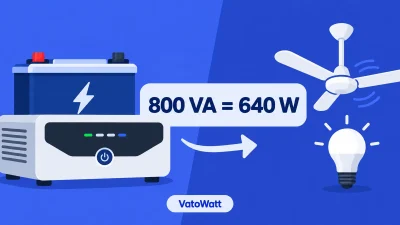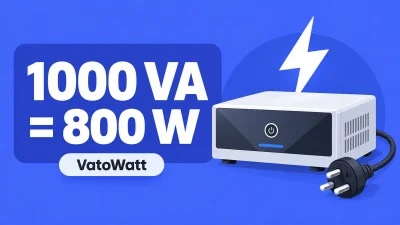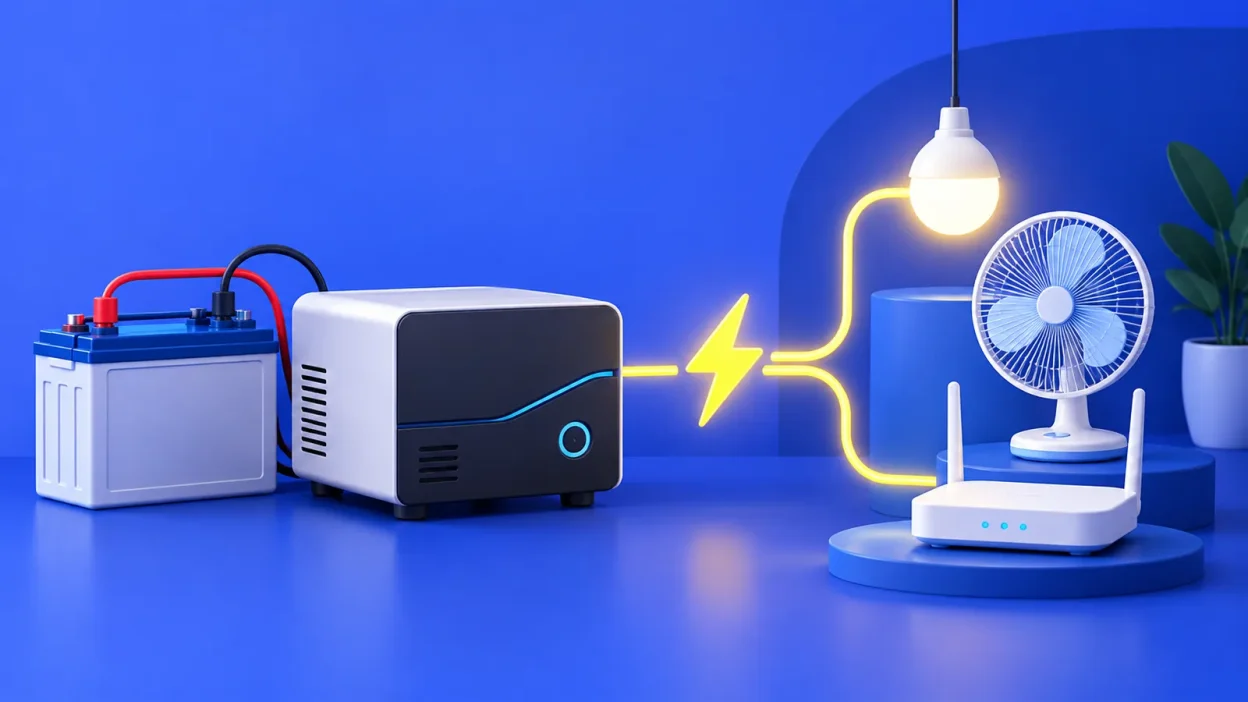
For 1100 va to watts, the quick answer is 880 W at a power factor (PF) of 0.8. The exact watt capacity depends on the PF and the inverter’s own output-watt specification, so use 880 W as the standard calculation rather than assuming every 1100 VA unit delivers the same load.
1100 VA to watts: 880 W at PF 0.8
The formula is:
Watts = VA × power factorSubstitute the numbers:
1,100 VA × 0.8 = 880 WSo, 1100 VA = 880 W when PF is 0.8. The result is 0.88 kW, because 880 W ÷ 1,000 = 0.88 kW.
VA means apparent power: the total AC capacity an inverter or UPS must handle. Watts mean real power: the power your fan, light, TV or charger actually uses. Power factor is the ratio between real power and apparent power. Eaton’s UPS handbook gives the same relationship as watts = VA × PF and VA = watts ÷ PF.
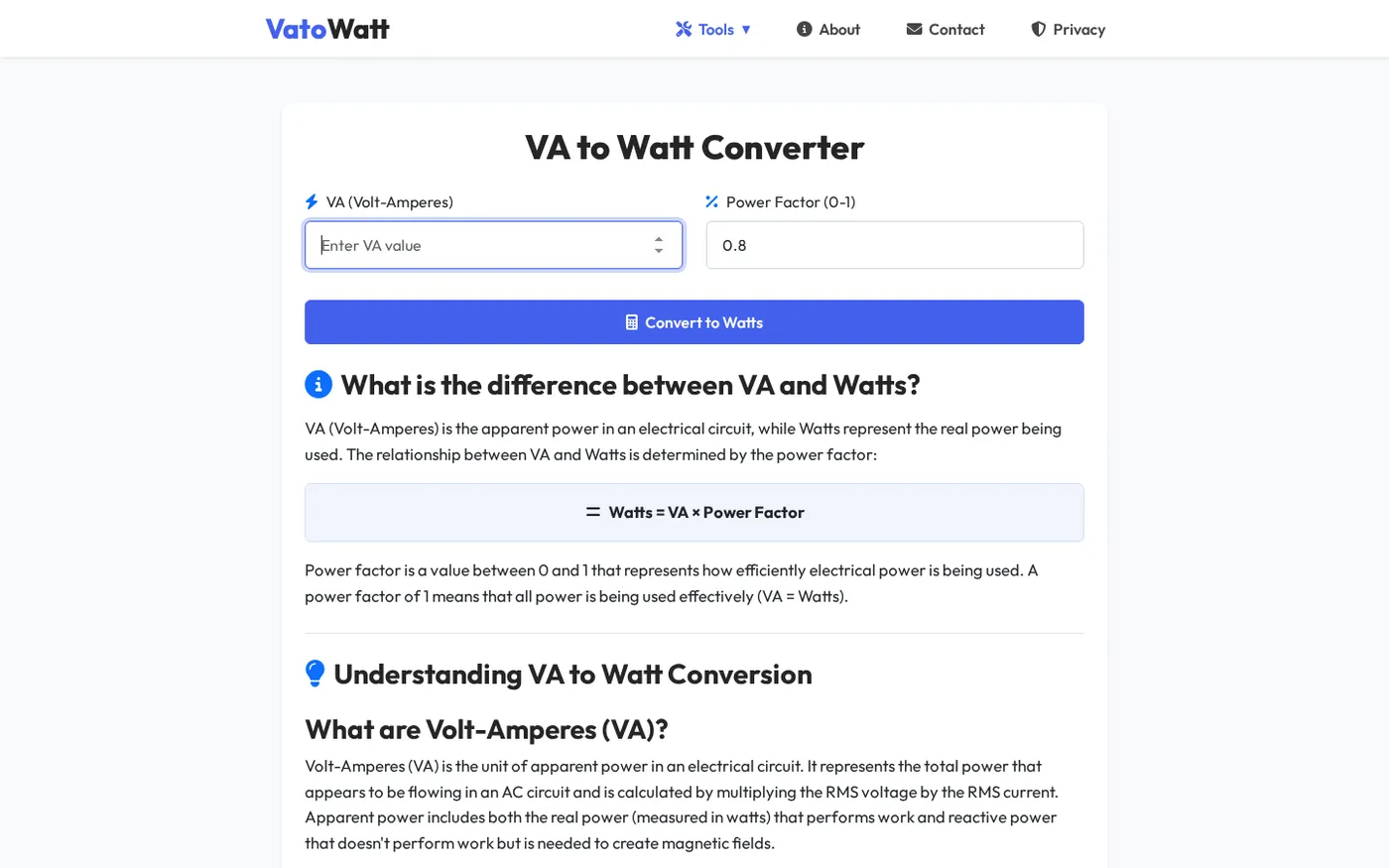
The calculator on VatoWatt’s VA to Watt Converter starts with PF 0.8 so you can repeat this calculation with another VA rating or a different PF.
Why the power factor changes the answer
1100 VA is not automatically 1100 W. That would be true only at PF 1.0, where apparent power and real power are equal. Loads with motors, compressors, transformers or some electronic power supplies can have a lower PF, so the same VA rating corresponds to fewer watts.
Here is the same 1100 VA rating at common example power factors:
| Power factor | Calculation | Real power |
|---|---|---|
| 0.6 | 1,100 × 0.6 | 660 W |
| 0.8 | 1,100 × 0.8 | 880 W |
| 0.9 | 1,100 × 0.9 | 990 W |
| 1.0 | 1,100 × 1.0 | 1,100 W |
Use the PF printed in the inverter or UPS data sheet when it is available. If you are checking a load instead, TDK’s power-factor explanation defines PF as active power in watts divided by apparent power in VA.
1125 VA and 1050 VA: nearby ratings
You may see 1125 VA or 1050 VA while comparing inverter listings. Apply the same formula instead of treating those labels as watts:
| Inverter rating | At PF 0.8 | At PF 0.9 |
|---|---|---|
| 1,050 VA | 840 W | 945 W |
| 1,100 VA | 880 W | 990 W |
| 1,125 VA | 900 W | 1,012.5 W |
The useful answer for 1125 VA to watts is therefore 900 W at PF 0.8. For 1050 VA, it is 840 W at PF 0.8. These are mathematical conversions; the product’s rated output watts still take priority when the manufacturer lists a separate limit.
A 2BHK load that fits under 880 W
Suppose you want backup for a typical small flat. This example adds the appliances that may run together, not every appliance in the home:
| Appliance | Quantity | Example watts each | Total |
|---|---|---|---|
| Ceiling fan | 4 | 70 W | 280 W |
| LED bulb | 6 | 9 W | 54 W |
| Television | 1 | 100 W | 100 W |
| Wi-Fi router | 1 | 12 W | 12 W |
| Laptop charger | 1 | 65 W | 65 W |
| Refrigerator, running estimate | 1 | 150 W | 150 W |
| Combined running load | 661 W |
The example is below 880 W, leaving 219 W between the calculated PF 0.8 capacity and the combined running load. Check the wattage printed on each appliance because fan, TV, refrigerator and charger ratings vary. The refrigerator’s compressor can also draw a higher starting surge than its running wattage.
For a safer sizing check, add the appliances that start or run at the same time and compare both watts and VA with the inverter’s data sheet. Victron’s inverter guidance also recommends checking continuous combined load and startup surge from motors and compressors, rather than sizing from one appliance alone. You can enter the whole list in the Inverter Load Calculator.
Battery backup for an 1100 VA inverter with a 150 Ah battery
VA tells you the inverter’s AC capacity. It does not tell you how long the battery will run the load. For a quick battery estimate, use:
Backup hours = battery Ah × battery voltage × efficiency ÷ load wattsFor a 150 Ah, 12 V battery, a 300 W load and 0.8 efficiency:
150 Ah × 12 V × 0.8 ÷ 300 W = 4.8 hoursThis is the calculator-style estimate for the stated inputs. If the load is the 661 W 2BHK example above, the same calculation becomes:
150 × 12 × 0.8 ÷ 661 = 2.72 hoursActual runtime changes with battery condition, temperature, load pattern and the inverter’s own losses. Do not use the 4.8-hour figure as a promise for every 1100 VA system. For a result in hours and minutes, use the Battery Backup Calculator. For the same formula explained with a wider set of examples, see Battery Backup Time Formula: Calculation Table.
Can 1100 VA run a fridge or cooler?
It can, if the appliance’s running watts, starting surge and the other loads together stay within the inverter’s rated watts and VA. A refrigerator or cooler uses a motor or compressor, so its startup demand may be higher than the number shown during normal running.
For example, adding a 150 W running refrigerator to lights, fans and a TV is not the same as checking the refrigerator alone. Read the appliance label or manual, include the other devices that will be on during a power cut, and check the inverter’s surge specification. If the total is close to the limit, leave out a high-power appliance during startup rather than relying only on the 880 W calculation.
Common mistakes when converting 1100 VA
- Treating VA as watts: 1100 VA is 880 W at PF 0.8, not automatically 1100 W.
- Ignoring the data sheet: a model may state a separate maximum output in watts. Use that manufacturer value when it is lower than the calculation.
- Using PF 0.8 for every load: PF is an input to the calculation, not a universal rating for all appliances.
- Checking only one appliance: fans, lights, a TV, router and fridge can run together during a power cut.
- Forgetting startup surge: motors and compressors may need extra capacity for a short time.
- Confusing capacity with backup time: VA helps describe inverter output; battery Ah, voltage, efficiency and load determine runtime.
FAQ
How many watts is 1100 VA at PF 0.8?
1100 VA at PF 0.8 is 880 W. Calculate it as 1,100 × 0.8 = 880.
Is 1100 VA equal to 1100 watts?
Only when the power factor is 1.0. At PF 0.8, 1100 VA equals 880 W; check the inverter’s stated output-watt rating for the final limit.
How many watts is 1125 VA?
1125 VA is 900 W at PF 0.8. At PF 0.9, it is 1,012.5 W, so the PF used in the calculation matters.
Can an 1100 VA inverter run a refrigerator?
It may, if the refrigerator’s running and starting demand fits within the inverter’s watt and VA limits along with the other connected appliances. Check the model data sheet and include compressor surge before deciding.
How long will a 150 Ah battery run an 1100 VA inverter?
There is no single runtime from VA alone. For example, a 150 Ah, 12 V battery at 0.8 efficiency gives 4.8 hours for a 300 W load using the stated formula; a larger load runs for less time.